In a nutshell
- 🧽 Kitchen sponges are microbial reservoirs thanks to moisture, food residues, and biofilms, meaning a “clean-looking” sponge can still spread bacteria.
- 🔥 Microwaves create moist heat that drives thermal inactivation of vegetative bacteria, but only if the sponge is uniformly heated throughout.
- 📊 Studies show big bacterial reductions, yet not guaranteed sterilisation; uneven heating and resilient spores can leave pockets of survivors.
- ⚠️ Real risks include scorching, sparks from embedded metal, and burns; public health guidance warns against relying on microwaving as a sole solution.
- ✅ Better hygiene: replace sponges often, hot-wash cleaning tools, let them dry fully, segregate tasks to cut cross-contamination, and treat microwaving as an imperfect last resort.
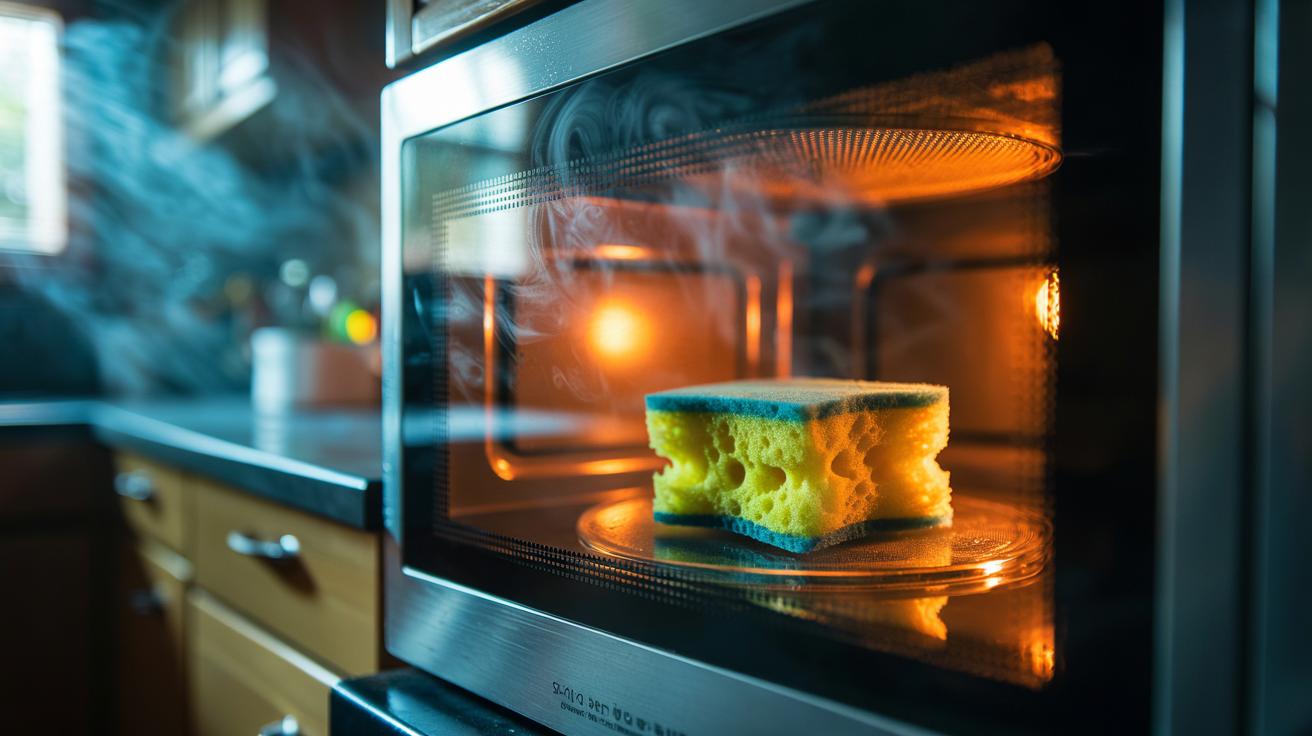
It is a strangely compelling household promise: pop a grimy sponge into the microwave and, in seconds, your biggest kitchen germ-magnet is as good as new. The idea rests on legitimate physics — microwaves energise water molecules, generating rapid, moist heat that can damage bacterial cells — yet the practice sits on a knife-edge between clever hack and hazardous half-measure. In busy UK kitchens where raw meat, fresh produce, and dairy mingle, the sponge occupies a risky crossroads. Quick heat can dramatically reduce microbes, but it does not guarantee true sterilisation every time. Understanding what heat can do, and the pitfalls of doing it badly, is essential before pressing “start”.
Why Kitchen Sponges Become Microbe Hotels
Sponges are built to soak up liquid and cling to food residues, a combination that turns them into microbial reservoirs. Their porous structure traps moisture and nutrients, allowing bacteria to thrive in protected nooks where detergent and rinsing seldom reach. Frequent contact with sinks, chopping boards, and plates links the sponge to multiple sources of contamination, from Salmonella and E. coli to harmless skin flora. Left damp on a worktop, a sponge offers precisely what microbes want — warmth, water, and a steady feed of organic matter.
Once established, microbial communities form biofilms that are harder to dislodge and more tolerant of stress. A quick cold rinse may reduce odour, yet viable cells often remain. This is why a sponge that “looks clean” can still seed a cutting board or a child’s beaker with bacteria. The upshot is clear: the best defence is to minimise conditions that favour growth and to choose cleaning methods that reach deep into those protected pores.
How Microwaves Deliver Rapid Heat
Microwave ovens generate electromagnetic waves that couple primarily with water molecules. That coupling produces fast, internal heating and, in wet items, a burst of moist heat and steam. Moist heat is particularly effective at thermal inactivation: it denatures proteins, damages cell membranes, and disrupts vital cellular machinery. Many vegetative bacteria die quickly when core temperatures pass roughly 60–70°C, provided there is adequate contact time. In principle, a soaked sponge can reach lethal temperatures in seconds, especially in hotspots where steam forms.
However, microwaves heat unevenly. Air pockets, dry corners, and dense zones create temperature gradients, leaving cold spots where microbes survive. Heat-resistant organisms, including some spores, can shrug off brief exposure. “Seconds” of heat only sanitise if the entire sponge — not just parts — spends sufficient time at the right temperature. That nuance is critical to interpreting lab results and kitchen outcomes alike.
| Microbe or Type | Typical Thermal Susceptibility (approx.) | Notes |
|---|---|---|
| E. coli (pathogenic strains) | Rapid die-off above ~65–70°C with short exposure | Moist heat inactivates efficiently when heat is uniform. |
| Salmonella | Similar to E. coli; needs sustained time above ~65°C | Cold spots can preserve viability. |
| Campylobacter | More heat-sensitive; inactivates near ~55–60°C | Readily killed if temperatures are even. |
| Norovirus (surrogates) | Reduced at ~60–70°C; requires adequate time | Viruses lack metabolism; inactivation depends on capsid damage. |
| Bacillus cereus spores | Survive brief heating; need much higher heat/time | Spores are notably resilient; microwaving may not suffice. |
Evidence: What Studies Show and What They Don’t
Laboratory experiments have reported large reductions in bacterial counts when sponges or scrubbing pads were exposed to high microwave power while thoroughly wet. The mechanism is clear: a brief period at lethal temperatures can slash populations by several orders of magnitude. Yet those same studies often note variability. Sponge material, water content, load of organic soils, and oven wattage all affect outcomes, as does how evenly heat penetrates. In real kitchens, where conditions are messy and inconsistent, results are less predictable.
Crucially, “sterilised” in everyday language is not the same as sterile by laboratory standards. Heat-resistant spores may persist, and uneven heating can leave pockets of survivors that rebound quickly once the sponge cools and stays damp. Some public health bodies caution against relying on microwaving at home because of these uncertainties and the risk of fire with dry items. The message from the evidence is balanced: microwaves can disinfect, but not reliably, and not universally.
Safety, Limits, and Better Hygiene Habits
Fire and injury are real risks if microwaving is attempted carelessly. Dry sponges may scorch, and any embedded metal (such as a scouring layer) can spark. Superheated spots can cause burns when removed. Detergent residues and grease may aerosolise. Because of these hazards and inconsistent results, many safety authorities prefer simpler, verifiable habits: rotate multiple cloths, hot-wash at 60°C or above, and let items dry fully between uses. Drying deprives microbes of the water they require to multiply.
In practice, move away from a sponge-does-all approach. Use colour-coded cloths for raw proteins and ready-to-eat areas, clean boards separately, and replace high-wear sponges frequently. A dishwasher cycle with a hot drying phase can help for some items; boiling water aids certain cloths but may damage foam. The most reliable “hack” is disciplined replacement and thorough drying, not a one-shot blast. Treat microwaving, if considered at all, as an imperfect, last-resort disinfecting step rather than a guarantee of sterilisation.
Microwave heat can dramatically reduce bacteria in a wet sponge, and the physics of moist heat explains why that seems to work “in seconds”. Yet uneven heating, resilient spores, and household hazards mean the promise outpaces reality. The safest route to a cleaner sinkside is a bundle of simple habits: replace sponges often, wash at high temperatures, keep tools dry, and segregate tasks to prevent cross-contamination. The smarter kitchen is not the one with the hottest hack, but the one with the most consistent routine. With that in mind, what changes could you make this week to keep your cleaning kit truly clean?
Did you like it?4.6/5 (24)