In a nutshell
- 🍋 The lemon + salt scrub brightens boards, lifts odours, and lowers microbial load by combining citric acid with gritty abrasion.
- 🧪 Acid action: low pH disrupts membranes and enzymes, while salt adds osmotic pressure and scrubbing power; effective on E. coli and Salmonella but not sterilisation.
- 🧼 Method: cover surface with coarse salt, scrub with a halved lemon, allow 3–5 minutes contact time, rinse hot, and air-dry upright; oil wood with food-grade mineral oil.
- ⚠️ Safety: use stronger sanitisers after raw meat; never mix acids with bleach; avoid lemon on marble/limestone and reactive metals; replace boards with deep grooves.
- 🪵 Best practice: keep separate boards for high-risk foods, prioritise thorough drying, and use dishwashers for suitable plastics as part of a layered hygiene routine.
There is a low-tech kitchen trick that feels oddly satisfying and genuinely useful: the classic lemon + salt scrub. It brightens dingy chopping boards, lifts onion and garlic odours, and curbs microbial build-up without a bottle of chemicals in sight. The secret sits in the fruit bowl. Lemon’s citric acid lowers pH, making life hard for many microbes, while coarse salt provides abrasion to dislodge grime lodged in knife scars. This is a cleaner’s two-step: chemical plus mechanical. It is not hospital-grade disinfection, yet it delivers visible whitening and a measurable reduction in germs—perfect for routine refreshes of wooden and plastic boards between heavier cleans.
Why Lemon and Salt Work
Citric acid is a weak organic acid with a powerful effect in the kitchen. At low pH, bacterial cell membranes lose integrity, enzymes misfire, and crucial metals are sequestered through chelation. That makes the surface on your chopping board inhospitable to common culprits such as E. coli and Salmonella. At the same time, coarse salt acts like thousands of tiny scrubbers, scouring tannin stains and food residues while also drawing moisture from the surface by osmotic pressure. The duo is effective because it pairs chemistry with friction. Lemon’s oils, including limonene, help to unstick greasy films and neutralise odours. On pale woods, the acidity can lightly lift pigments, creating the familiar “just-sanded” look. Expect a visibly brighter board and a reduced microbial load, but not sterilisation. Plastic boards also benefit, though deep knife grooves can shelter microbes beyond the reach of a quick scrub.
Step-By-Step: The Lemon + Salt Scrub
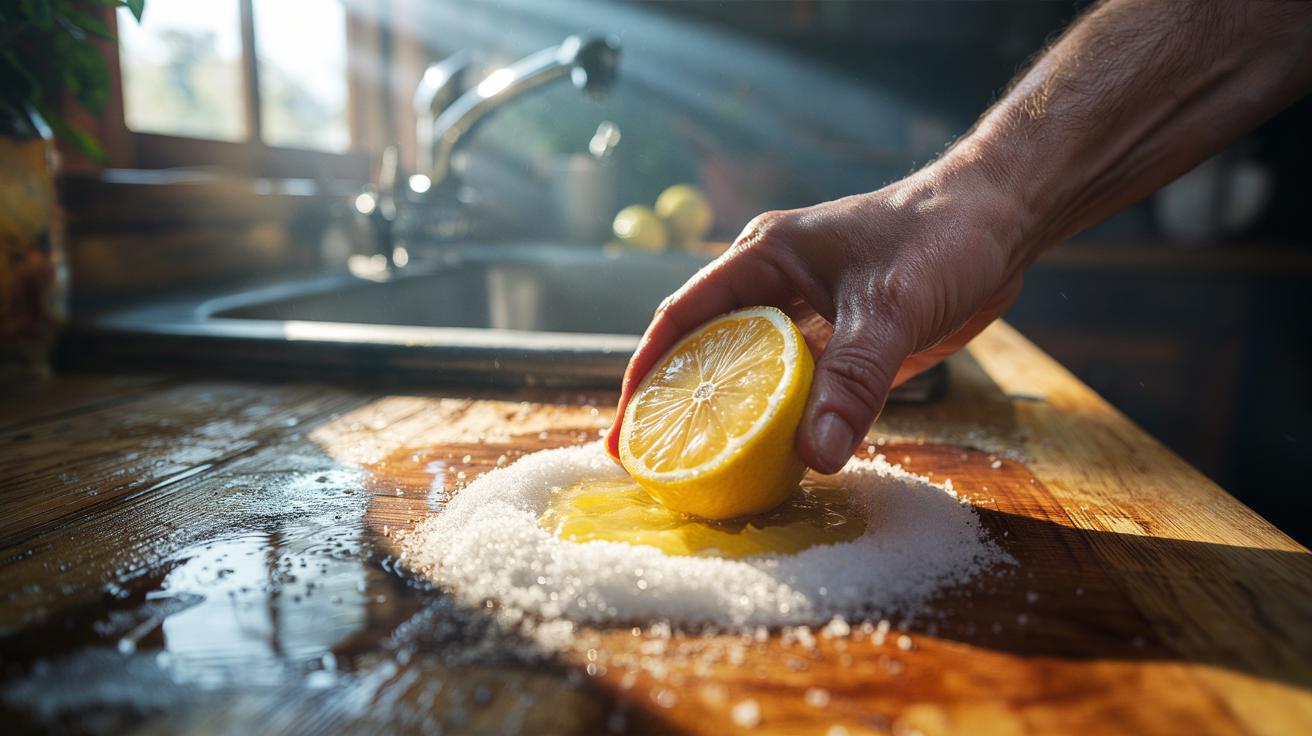
Start with a clean sink and a dry board. Sprinkle a generous layer of coarse salt across the surface—fine salt dissolves too quickly for effective abrasion. Halve a fresh lemon, squeeze a little juice over the salt, then use the cut face as your scrubber, working along the grain on wood. Allow the slurry to sit for 3–5 minutes to give the citric acid time to act. Scrub again, focusing on knife scars and stained areas, then rinse with hot water and wipe dry. Stand wooden boards upright to air-dry completely. For longevity, finish with a thin coat of food-grade mineral oil on wood. Avoid prolonged contact on reactive metals, and never use lemon on marble or limestone, where acid can etch. For plastic boards, this method refreshes the surface, but a periodic dishwasher cycle remains wise.
What Science Says About Acid and Germs
Acidic environments disrupt the biology of many microbes. Low pH affects membrane transport, denatures proteins, and can collapse proton gradients. Laboratory tests with citric acid solutions often show modest yet meaningful reductions in foodborne pathogens—commonly in the order of ten- to thousand-fold decreases—when paired with adequate contact time and physical agitation. This makes lemon a useful sanitising adjunct, not a silver bullet. Spores and some viruses are notably resilient; established biofilms in deep grooves are also more resistant. Mechanical scrubbing is the force multiplier: it removes biomass so acid reaches cell surfaces. Compared with bleach, acids are gentler and leave fewer residues but act more slowly and are less comprehensive. In kitchens, combining smart technique (friction, contact time, thorough drying) with acid gives a practical middle ground between a quick wipe and full chemical disinfection.
| Method | Targets/Effect | Typical Contact Time | Best For | Key Caution |
|---|---|---|---|---|
| Lemon + Salt | Reduces bacteria; lifts stains; deodorises | 3–5 minutes | Routine refresh of wood/plastic | Not a high-level disinfectant |
| Diluted Bleach | Broad-spectrum disinfection | 1–5 minutes | After raw meat/poultry | Never mix with acids |
| Hydrogen Peroxide | Oxidises microbes; no chlorine smell | 5–10 minutes | Plastic boards, non-porous | Store away from light/heat |
| Dishwasher Cycle | Heat + detergent clean | Full cycle | Dishwasher-safe plastics | Avoid for wooden boards |
Safety, Limits, and When to Use Something Stronger
In food safety terms, context matters. Use lemon and salt for everyday odours, surface stains, and general tidiness. After preparing raw meat, eggs, or seafood, step up to a proven sanitiser: a properly diluted bleach solution on plastic or a dedicated meat board that can go through a hot dishwasher cycle. Keep a separate wooden board for bread, fruit, and herbs to limit cross-contamination. Deep knife scars harbour biofilms; plan to resurface or replace boards with heavy scoring. Never combine lemon with bleach—the mix can release chlorine gas. Avoid leaving acid on stone or cast iron. Above all, drying is non-negotiable: microbes struggle on clean, dry surfaces, so store boards upright with airflow. A quarterly oiling routine will protect wood, making future cleaning more effective and less aggressive.
The lemon-and-salt scrub earns its place by delivering brightened boards and a cleaner baseline with little more than pantry staples. By exploiting low pH and gritty abrasion, it removes stains and reduces everyday microbes while keeping harsh chemicals at bay. Use it as part of a layered approach: smart segregation of boards, thorough drying, and occasional high-level sanitising when risk is higher. Think of it as preventive care rather than emergency medicine. What’s your current board-care routine, and where could a simple switch—like a fresh lemon and a pinch of salt—make the biggest difference in your kitchen?
Did you like it?4.5/5 (27)