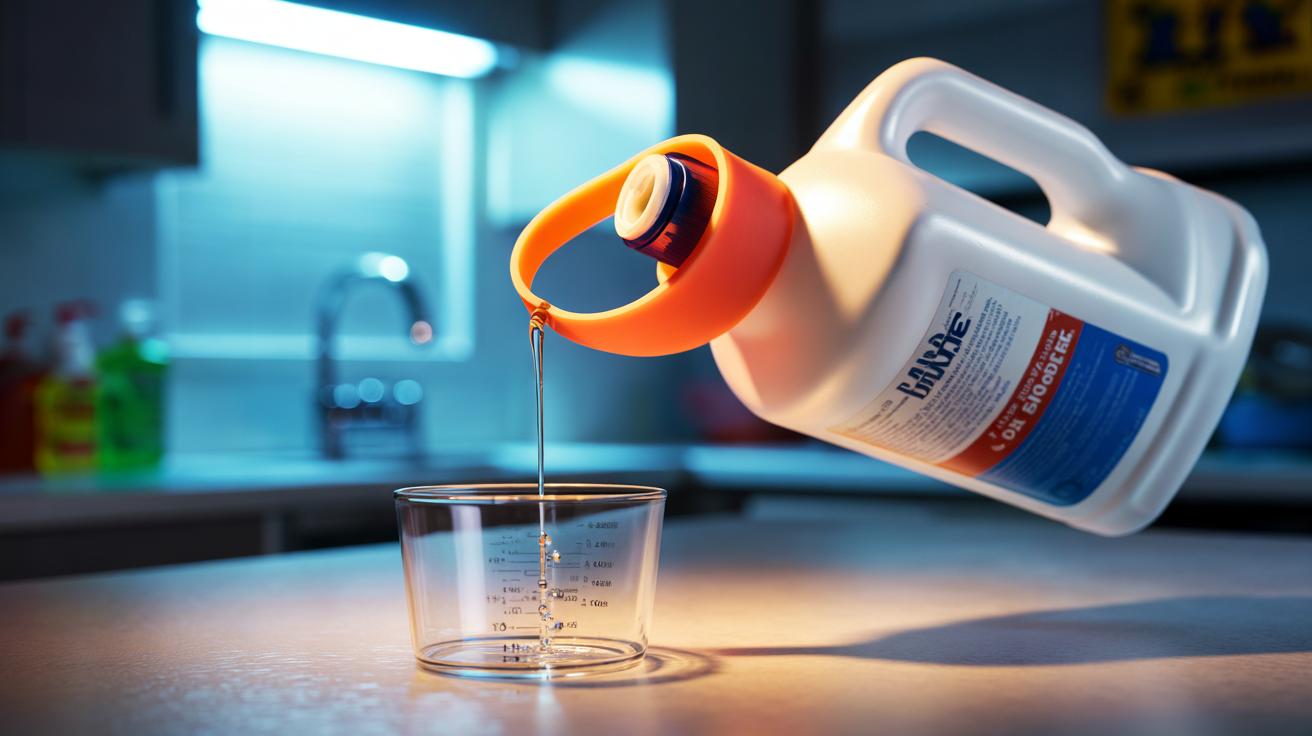
In a nutshell
- 💧 Explains why drips form on bleach bottle rims: surface tension, wetting, and capillary creep that gather into a droplet and streak labels.
- 🧪 Shows how a rubber band acts as a micro-weir, pinning the meniscus to create a clean pouring edge and halt run-off.
- 🛠️ Provides setup guidance: place the band 5–10 mm below the lip, consider two thin bands with a 2–3 mm gap, and test with water first.
- 🧷 Compares materials: silicone and EPDM/nitrile resist bleach and outlast natural rubber; grip and longevity differ by material.
- ✅ Emphasises safety and value: wear gloves, ventilate, never mix bleach with acids or ammonia, and achieve cleaner bottles for pennies.
Sometimes the smartest household hacks are the simplest. A humble rubber band stretched around the neck of a bleach bottle can stop those maddening drips that streak the label, stain the cupboard, and leave your hands smelling like a swimming pool. This tiny intervention reshapes how liquid leaves the rim, creating a clean pouring edge without buying a new container or spout. It’s thrifty, tidy, and surprisingly elegant. Below, we unpack the science that makes it work, the best way to set it up safely, and why this quick fix suits UK homes where compact storage and rigorous hygiene both matter.
Why Drips Form on Bleach Bottle Rims
After you tip a bottle back upright, surface tension and wetting conspire to pull a thin film of liquid along the outside rim. Bleach bottles are typically made from HDPE, whose texture allows a sheen of fluid to cling and creep. That thin film, driven by capillary action and gravity, gathers into a bulb at the lowest point. Once the bulb grows heavy enough, it falls as a drip—and often repeats. The “glug” of air re-entering also shakes liquid against the lip, feeding more run-off. Even careful pourers notice a faint rivulet down the label, because the meniscus prefers a continuous path rather than a clean break.
Geometry matters. Rounded lips encourage a smooth, attached flow; there’s less of a sharp edge to shear the liquid away from the surface. In fluid dynamics, the flow detaches when it meets a discontinuity—something that interrupts the meniscus and forces a clean pinch-off. Without it, low-viscosity liquids like bleach keep crawling. That’s why anti-drip spouts and angled lips exist: they create a deliberate energy barrier for the film. The good news is that a simple elastic ring provides a comparable barrier, repositioning the break point and starving the forming droplet before it can fall.
How a Rubber Band Creates a Clean Pouring Edge
Placed just below the bottle’s mouth, a rubber band acts as a micro-weir. As the residual film tries to travel down the neck, it meets the band’s raised edge. That ridge increases curvature and locally boosts surface tension forces, which pin and thin the film. The flow separates at the ridge, causing a tidy meniscus break rather than a sagging bulb. In effect, the band becomes a sacrificial edge that captures the last trace of liquid and prevents a drip from migrating onto the label. The result is a noticeably cleaner pour and a dry bottle exterior after you set it down.
Material and texture amplify the effect. Slightly tacky elastomers create friction that slows the creeping film, while the band’s tiny surface roughness disrupts the sheet of liquid into minute beads too small to coalesce. In practice, this “capillary break” either holds a pinhead droplet that evaporates or channels it back when the bottle is next tipped. By moving the edge where the pour detaches, the band gives the bottle the sharp lip it never had. It’s cheap, reversible, and works on most household bleach packaging.
Practical Setup: Placement, Materials, and Safety
Fit one band snugly around the neck, 5–10 mm below the mouth. Test with water first to confirm where the film tries to creep, then nudge the band slightly lower or higher until the run-off stops. Two thin bands can outperform one thick band by creating a double ridge; leave a 2–3 mm gap. Do not overtighten—excess tension can roll the band up the neck mid-pour. Choose bands wide enough (3–5 mm) to present a clear edge, and wipe the neck clean before fitting so residue doesn’t bridge over the ridge.
| Band Material | Bleach Resistance | Grip on Bottle | Longevity | Notes |
|---|---|---|---|---|
| Natural rubber | Moderate | Good | Weeks–months | Cheap; may perish with bleach; replace regularly. |
| Silicone | High | Very good | Months–year | Stable and washable; slightly pricier; excellent ridge. |
| EPDM/Nitrile | High | Good | Months–year | Great chemical resistance; common in hair ties/O-rings. |
Stay safe. Wear gloves if skin-sensitive, ventilate well, and never mix bleach with ammonia or acids. Rinse any residue from the band during bottle refills to prevent crystallised deposits that could undermine the seal. If your cap includes a child-safe over-sleeve, position the band so it doesn’t interfere with closing. For heavy-duty cleaning, consider a measuring jug to decant accurately—pairing a jug with the band cuts both splash and streaks. Replace fatigued bands at the first signs of cracking.
Comparing the Hack With Other Anti-Drip Strategies
You can buy anti-drip spouts or decant into a purpose-made dosing bottle, but the elastic trick is fast, free, and adaptable. Angled-lip funnels give a crisp pouring edge; the band mimics this by creating a ridge. Slow, steady tilts reduce the post-pour rivulet, though that’s hard to maintain with heavy 2-litre containers. If your bottle “glugs,” loosening the cap slightly can admit air smoothly, reducing shake that feeds rim run-off. Some UK brands add internal vents; if yours has one, the band still helps with the lingering film after flow stops.
Cost is compelling: a packet of mixed rubber bands costs pennies and serves multiple bottles from bleach to thickened disinfectants. Field tests in household conditions show fewer label stains and cleaner cupboards after a week of regular use. For very thin liquids, two bands perform better than one; for viscous gels, a single ridged silicone band often suffices. The only trade-off is aesthetics—you’ll see the band—but the payoff is a reliably dry exterior.
In the quiet theatre of the cleaning cupboard, a tiny ridge can rewrite fluid behaviour. The rubber band hack interrupts capillary action, pins the meniscus, and gives a humble bleach bottle the clean pouring edge of a premium spout. It’s quick to fit, cheap to maintain, and simple to test with water before committing. For best results, match the band to the bottle, position it 5–10 mm below the lip, and replace it when it dulls. What other everyday objects could you repurpose to tame messy flows around the home—and which one will you try next?
Did you like it?4.7/5 (26)