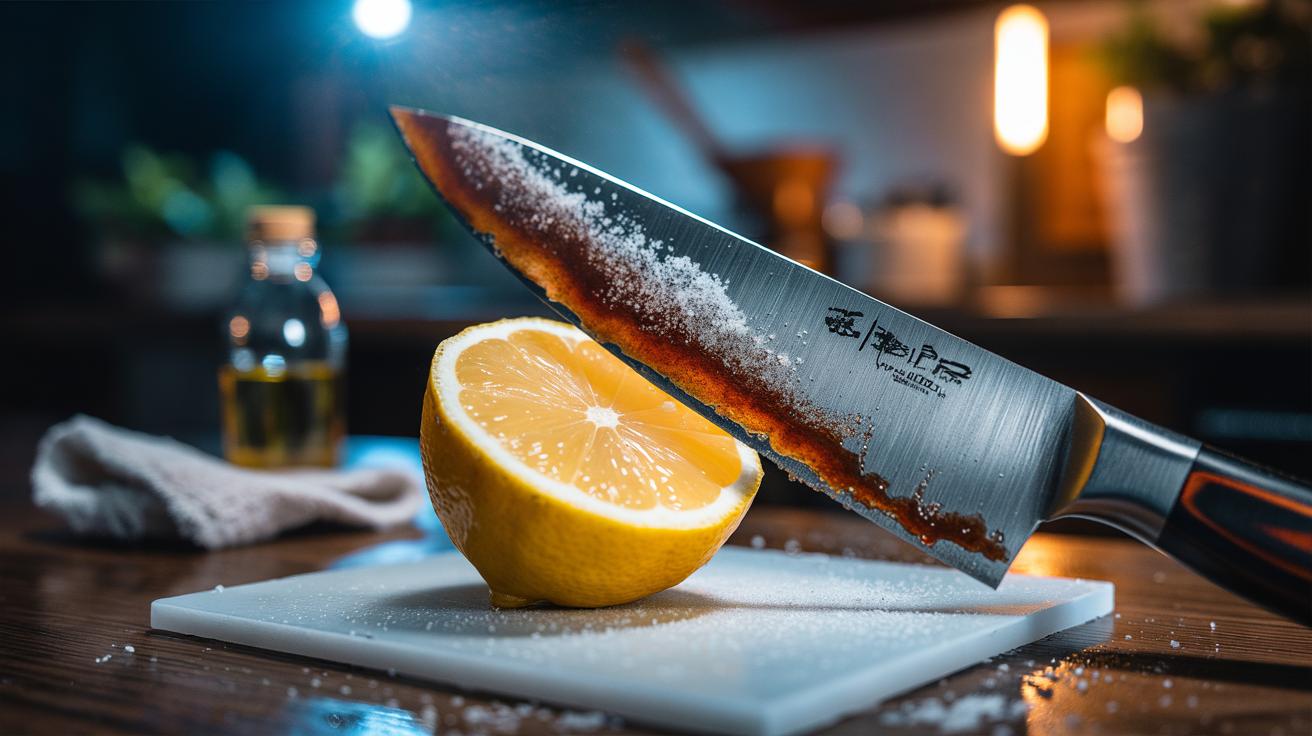
In a nutshell
- 🔬 The pantry pairing works because citric acid dissolves iron oxides via chelation, while salt adds micro‑abrasion and chloride ions that disrupt oxide layers—then thorough rinsing prevents pitting and supports natural re-passivation.
- 🧽 Method: clean and dry, coat rust with coarse salt, add lemon juice and rub with the cut lemon, build a paste, lay flat, wrap damp if needed, leave 1–12 hours, then rub, rinse, soap-wash, dry, and finish with food-safe mineral oil (keep liquid off wooden handles and watch the sharp edge).
- ✨ Results and limits: orange/brown films lift for a brighter, smoother surface; deep pits won’t “fill” but are arrested; carbon steel may deepen its patina; stainless regains uniformity—repeat once rather than over-soaking.
- 🛡️ Aftercare: dry thoroughly—especially the spine–handle junction—apply a light oil film, store on a ventilated magnetic strip or dry block, skip dishwashers, wipe after acidic foods, and add silica gel to drawers to deter moisture.
- 📊 Quick guide: Light film 1–2 h; Moderate spots 4–6 h; Stubborn patches 8–12 h, with increasing abrasion—post-treatment is always rinse, wash, dry, oil for safe, lasting results.
Rust blooms on a favourite chef’s knife are more than a cosmetic nuisance; they can roughen the edge, snag on food, and shorten the tool’s life. A low-tech kitchen fix—coarse salt and fresh lemon—uses everyday chemistry to lift corrosion while being gentle on steel. The natural citric acid chelates iron oxides and the crystals provide mild abrasion, meaning you get a cleaner blade without harsh fumes or specialist gear. Handled correctly, this overnight rub targets oxidised layers while preserving the cutting geometry you paid for. Here’s how the reaction works, how to do it safely, and what results to expect by morning.
Why Salt and Lemon Work on Rust
Rust is mainly iron oxides, porous and brittle compared to the underlying steel. When you coat a blade with lemon juice, the low pH helps break down that oxide. The acid’s citrate ions form stable complexes with Fe2+ and Fe3+, encouraging the oxide to dissolve into solution. Coarse salt granules add micro-abrasion, letting fresh acid reach deeper pockets. The goal is to dissolve iron oxides faster than you etch sound steel, achieving a controlled clean rather than an aggressive strip.
Salt isn’t only grit: its chloride ions disrupt oxide layers and increase the mobility of iron ions into solution. That accelerates removal but also raises a caveat—chlorides left on the blade can promote pitting if not rinsed. A brief, supervised soak and a thorough wash remove residues and help the blade re-passivate naturally. Used with care, the salt–lemon pairing is a precise rust remedy, not a blunt instrument.
Step-by-Step Method for a Safe Overnight Rub
Clean the blade with warm soapy water and dry completely. Sprinkle a thin, even layer of coarse salt over the rusty areas. Halve a fresh lemon and squeeze enough juice to wet the salt, then use the cut lemon as a gentle rubbing block, pushing the crystals across the oxide. Build a grainy paste; avoid the sharpened edge contacting your fingers. Keep liquid away from wooden handles or carbon-steel tangs that could swell or stain.
Lay the knife flat on a non-reactive surface and apply a final coating of the paste. For light rust, 1–2 hours can suffice; for stubborn patches, wrap the blade in a lemon-damp paper towel and leave up to 8–12 hours. In the morning, rub with a soft cloth or non-scratch pad, then rinse thoroughly, wash with soap, and dry immediately. Finish with a wipe of food-safe mineral oil. Do not leave chloride-rich residues—rinsing is non-negotiable.
What to Expect: Results, Limits, and Knife Care
A successful treatment lifts orange and brown oxide films, revealing a brighter surface and a smoother feel under the thumb. Minor spot corrosion vanishes; darker specks may remain where pits formed below the surface. Rust removal cannot fill pits—it arrests the damage and cleans the cavity walls. Carbon steel may darken slightly as its patina evens out; stainless will look uniform if the original finish remains intact. If rust persists, repeat once more rather than extending a single long soak.
After cleaning, dry the knife completely, especially at the spine–handle junction, then oil lightly. Store blades in a dry block or on a magnetic strip with air circulation. Avoid dishwashers, wipe knives after cutting acidic foods, and consider a silica gel pack in your drawer. Remember: stainless steel is stain-less, not stain-proof. The routine that prevents recurrence is simple—clean promptly, dry well, oil sparingly, and stow smart.
| Rust Severity | Contact Time | Abrasive Level | Post-Treatment |
|---|---|---|---|
| Light film | 1–2 hours | Fine salt, gentle rub | Rinse, dry, oil |
| Moderate spots | 4–6 hours | Coarse salt, lemon rub twice | Rinse, wash, dry, oil |
| Stubborn patches | 8–12 hours | Coarse salt, non-scratch pad | Rinse, wash, dry, oil; repeat if needed |
The Chemistry in Brief
Citric acid donates protons that react with iron oxides, while citrate ligands chelate the released iron, shifting equilibrium toward dissolution. The process can be sketched as oxide plus acid yielding solvated iron and water, with citrate stabilising Fe3+ complexes. Salt’s chloride boosts ion mobility and disrupts oxide continuity, letting acid penetrate crevices. This tandem—acid plus chloride plus abrasion—explains why a pantry remedy competes with proprietary gels.
There are limits. Extended exposure can dull polished finishes and, if residues remain, chloride can encourage pitting, particularly on lower-alloy stainless. That is why thorough rinsing, a brief soap wash, and immediate drying are built into the method. A final oil film slows oxygen and moisture access while the steel re-passivates. If you’re restoring high-value blades or patterned steels, test on a small area first. Chemistry unlocks the rust, technique preserves the knife.
This humble rub works because it gives the chemistry a nudge and the corrosion nowhere to hide. It is fast to stage, easy to supervise, and kinder to your kitchen than harsh acids or aggressive sanding. Once you see the edge glide through onions again, the habit of quick cleaning and drying becomes second nature. Ready to rescue a neglected blade tonight—and what twist will you add, perhaps a final baking-soda rinse to neutralise any lingering acidity?
Did you like it?4.4/5 (25)