In a nutshell
- 🧵 A rolled towel forms a coarse filter that slows airflow, boosting collisions and capture of airborne particles via interception, inertial impaction, and Brownian motion.
- 🧺 Best setup: use dense microfibre or plush terry, roll tightly to seal the entire threshold, place on the upwind side, and consider slight dampness to improve fine particle retention.
- 📊 Limits: great for PM10 and some PM2.5, but not gases like VOCs or ultrafines; it’s a complement, not a substitute, for HEPA filtration.
- 🛡️ Hygiene and safety: shake outdoors daily, launder at 60°C weekly, dry fully to avoid mould, and never obstruct certified fire doors or critical ventilation paths.
- 🔋 Bonus: reduces draughts and heat loss; combine with brush seals, door sweeps, and a HEPA purifier for a layered, low-cost dust-control strategy.
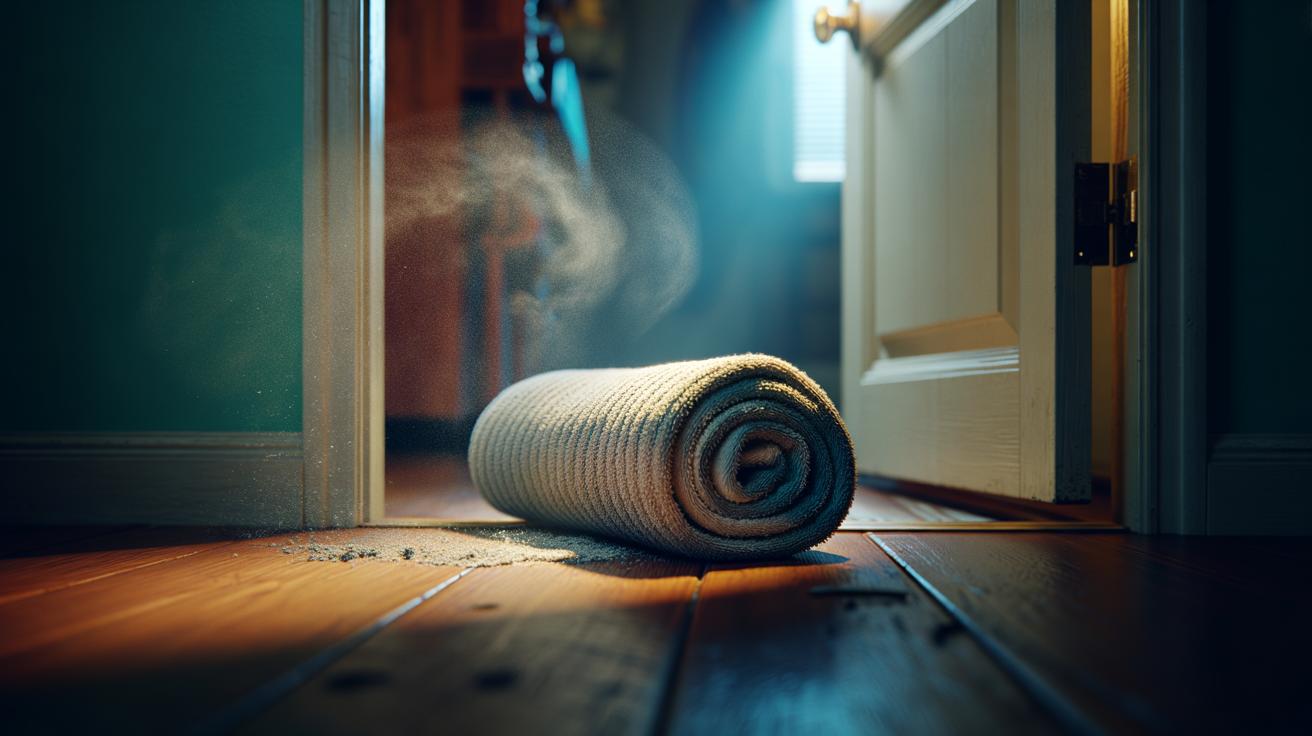
Shoving a towel along the threshold is a classic British hack for keeping a chilly draught at bay, yet there’s a quieter benefit: it also snags the dust that rides those small currents. As air slips beneath a door, it carries airborne particles—skin flakes, soot, pollen, fragments of textile fluff. A rolled towel creates a dense, fibrous barrier that slows the flow and turns the gap into a crude filter. By reducing velocity and adding a maze of fibres, you raise the chances that particles collide, stick, and stay put. It’s not laboratory-grade, but under the right conditions this domestic stopgap can meaningfully cut transfer of dust between rooms.
Why Towels Trap Dust at the Door
Towels work because fabric fibres form an irregular, porous web. As air squeezes through, particles encounter three helpful forces: interception (they brush a fibre and adhere), inertial impaction (larger bits can’t corner with the airflow and crash into fibres), and Brownian motion (tiny particles wander randomly and bump into threads). A slower, more tortuous path multiplies these collisions. Add a little humidity from ambient air or a lightly dampened pile and the fibres become slightly tackier, improving capture of fine dust. The effect is most visible when there’s a pressure difference—central heating on one side, a leaky window on the other—driving an under-door trickle that the towel both blocks and filters.
Fibre geometry matters. Loop-pile terry has thousands of protruding loops that snag particles efficiently; microfibre weaves provide a higher surface area and can attract fines via mild electrostatic effects. Compression helps too. A towel that’s rolled firmly and wedged snugly against the door turns loosely woven cloth into a compacted filter mat. The aim is contact: the fewer open channels at the threshold, the less unfiltered bypass. Think of it as a coarse pre-filter, intercepting the bigger and stickier fraction of household dust before it migrates into your bedroom or hallway.
Choosing the Right Fabric and Setup
For dust capture, density and pile beat sheer thickness. A microfibre towel or a plush cotton terry bath sheet both outperform a thin tea towel. Roll from the long end to make a uniform cylinder, then press it against the door so it spans skirting to skirting. Ensure the towel spans the entire threshold, with no visible light leaking beneath. In UK homes, door gaps often run 6–15 mm; a roll roughly 80–120 mm in diameter usually seals well without impeding the latch. Slightly damp—not wet—fabric can boost adhesion of fines but needs daily drying to prevent mustiness.
| Particle Size | Dominant Capture Mechanism | Fabric Note | Likely Outcome |
|---|---|---|---|
| PM10 (dust, pollen) | Inertial impaction, interception | Terry loops catch larger fragments | High capture at door gap |
| PM2.5 (smoke, soot) | Interception, diffusion | Microfibre improves surface contact | Moderate capture, some bypass |
| <0.1 µm (ultrafine) | Diffusion (Brownian) | Slight dampness helps retention | Low capture; better with tight seal |
Placement matters as much as material. Set the roll on the “upwind” side to reduce driven leaks, and tuck the ends against frames to close edge gaps. If the door swings often, consider a sewn fabric draught excluder with light chain weighting. A stable seal reduces turbulence that can fling captured dust back into the room. For flats near busy roads or rail lines, pair the towel with window sealing and an air purifier to control soot migration holistically.
What It Can and Cannot Do
A towel is a coarse filter and a draught block, not a replacement for HEPA filtration. It excels at intercepting settled dust re-entrained by footfall, pet dander, and fibres shed from clothing. It will modestly cut PM2.5 if the seal is tight and the fabric is dense, yet it won’t neutralise gases such as VOCs or nitrogen dioxide. If you can smell cooking odours, those molecules are too small and too mobile for towel fibres to stop. Similarly, wildfire or cigarette smoke includes ultrafine particles that can slip through unless velocity is very low.
There are practical limits. You’ll reduce door clearance, so don’t use the trick on a frequently used corridor where it becomes a trip hazard. Do not wedge a towel under a certified fire door in communal areas or block smoke seals. In homes where ventilation is already marginal, sealing too many internal gaps can increase indoor humidity and condensation. The tactic works best as a targeted measure—bedrooms during pollen season, nursery doors during cleaning, or to isolate a dusty DIY zone temporarily.
Hygiene, Safety, and Energy Considerations
Captured dust contains skin microbes, mite allergens, and combustion residues, so hygiene is non-negotiable. Shake the towel outdoors daily and launder at 60°C weekly, using fragrance-free detergent if allergies are a concern. A damp towel must be dried thoroughly after use to prevent mould growth. Choose a darker colour to hide staining between washes, and rotate two towels so one can air. If you’ve pets, a lint roller before washing reduces fur build-up and helps the fibres stay grippy rather than matted.
There’s a small energy bonus. By choking a leaky threshold, you limit convective heat loss and cold draughts, smoothing room temperatures and comfort. Combine the towel with basic maintenance—brush seals, a door sweep, a letterbox cover—and you’ll reduce both dust ingress and heating demand. The best outcomes pair source control with filtration: keep outdoor particles out, trap indoor dust at barriers, and clean what remains with a HEPA purifier or vacuum. Think of the towel as the cheapest first stage in a layered strategy.
Used thoughtfully, the towel-under-door fix is a shrewd, near-zero-cost way to corral dust while improving comfort. Its strength lies in simple physics: fibres slow air, collisions increase, and particles stick. It won’t banish smoke or gases, and it isn’t suited to fire doors or spaces that need constant ventilation, yet for bedrooms, home offices, and nurseries it can make a noticeable difference. With regular washing and a careful seal, the humble towel becomes an effective pre-filter. How might you combine this low-tech barrier with smarter ventilation and filtration to keep your home both cosy and clean?
Did you like it?4.6/5 (28)