In a nutshell
- 🔬 The vinegar-steam method works by combining steam’s latent heat with mild acetic acid to rehydrate residues, relax proteins and sugars, melt fats, and dissolve mineral crusts.
- ♨️ Simple routine: mix 250 ml water with 1–2 tbsp vinegar, heat on high for 3–5 minutes, then let it steam-soak for 3–5 minutes before wiping with a warm microfibre cloth.
- 💧 Inside the microwave, vapour condenses on cooler walls, releasing heat that plasticises caked-on food and reduces adhesion, making grime lift off with minimal effort.
- 🧪 Safety and odour control: use a microwave-safe bowl and a wooden stick to curb superheating; never mix vinegar with bleach; tackle smells with lemon slices or bicarbonate in a separate step; prioritise contact time.
- ✅ Long-term care: a weekly light steam prevents build-up, protects enamel and door seals, is low-cost and low-chemical, and saves significant scrubbing time.
Sticky splatters, caramelised sugars, and greasy films cling to microwave walls with stubborn tenacity. Yet a simple kitchen duet—heat and vinegar—can make them yield without harsh scrubbing. When a small bowl of diluted vinegar is heated, the resulting vinegar steam softens residues, dissolves mineral crusts, and loosens the bonds between food and enamel. Steam’s latent heat and moisture unlock the dried matrix of proteins, starches, and fats; acetic acid adds a gentle chemical nudge. Let the steamy atmosphere do the heavy lifting and save your wrists for a quick, clean wipe. Here’s why the method works, how to do it safely, and what science says about heat’s knack for ungluing grime.
The Chemistry Behind Vinegar Steam
The magic rests on two allies: steam and acetic acid. Steam delivers intense energy as it condenses on cooler microwave walls, releasing latent heat that rehydrates and softens dried residues. Water molecules penetrate microscopic pores in splatters, lowering viscosity and coaxing hardened sugars and sauces back toward a pliable state. Meanwhile, dilute acetic acid lightly acidifies the moisture film, helping to disrupt calcium-rich deposits and break weak ionic interactions that can “cement” grime to the cavity. This warm, acidic mist reduces adhesion and lets a cloth lift off what once felt baked on.
Sugars that have passed their glass transition and proteins crosslinked by heat respond to moisture by relaxing their structure. Fats that have oxidised or dried at the surface will re-liquefy as temperatures rise, reducing friction as you wipe. Acetic acid also neutralises odours by shifting the pH environment that sustains them. The result is a one-two punch: physical softening via heat and hydration, plus gentle chemical assistance from a food-safe acid that leaves no harsh residue.
Step-by-Step: The Vinegar-Steam Routine
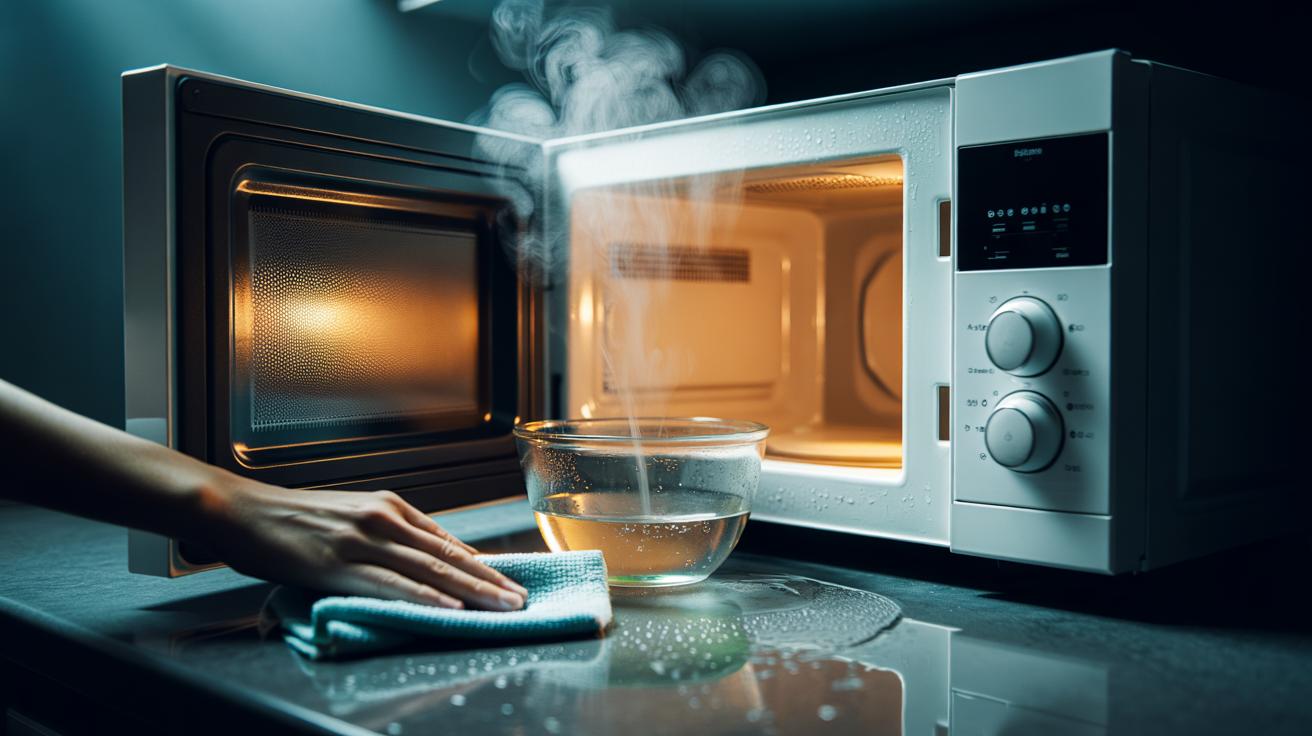
Use a microwave-safe bowl with 250 ml water and 1–2 tablespoons of white vinegar. Place it near the centre, add a wooden stir stick or a microwave-safe utensil to minimise superheating, and heat on high until a rolling steam forms—usually 3–5 minutes depending on wattage. Always let the bowl sit with the door closed for another 3–5 minutes to saturate the cavity with hot vapour. Carefully remove the bowl, then wipe walls, ceiling, and turntable with a warm, damp microfibre cloth. Stubborn corners give way after a second pass.
| Step | Setting / Ratio | Tip |
|---|---|---|
| Mix | 1–2 tbsp vinegar in 250 ml water | White distilled vinegar avoids staining |
| Heat | High power, 3–5 minutes | Include a wooden stick to reduce superheating risk |
| Steam soak | Door closed, 3–5 minutes | Contact time matters |
| Wipe | Damp microfibre cloth | Add a tiny drop of washing-up liquid for greasy zones |
| Finish | Dry and ventilate | Leave door ajar to dissipate odours |
How Heat Loosens Caked-On Food Inside a Microwave
Microwaves excite polar molecules, mainly water, generating heat within the liquid faster than the surrounding air can absorb it. When that water becomes vapour, it seeks cooler surfaces, condenses, and releases energy directly onto the grime. This micro-condensation hydrates and plasticises baked-on layers, softening carbohydrate networks and lowering the apparent “glassiness” of dried sauces. Latent heat at the surface is the key unlock—more effective than simply warming the air. Once residues absorb moisture, their polymer-like matrices relax, making the film far easier to shear off with a light wipe.
Fats respond to temperature by melting, sliding out from under the cloth rather than smearing. Proteins that have coagulated regain flexibility when hydrated. Even mineral halos from splatters yield as acetic acid forms soluble acetates with calcium, undermining the crust so it flakes away. The combination of heat-softened texture, reduced interfacial tension, and mild acidity transforms stubborn adhesion into removable film, avoiding abrasive pads that can dull the interior.
Safety Tips, Odour Control, and Long-Term Care
Choose a stable, microwave-safe vessel and avoid filling it to the brim. Insert a non-metal stir stick to cut the risk of superheating. Never mix vinegar with bleach or chlorine-based cleaners. Open the door carefully, keeping hands out of the first plume of steam. If your microwave has a humidity sensor, shorter cycles may suffice; the important variable is contact time with hot vapour. For very greasy ovens, a post-steam wipe with a tiny drop of washing-up liquid followed by a clean rinse cloth prevents streaks.
To tame lingering curry or fish odours, repeat the steam with lemon slices or a teaspoon of bicarbonate in a separate bowl after the vinegar step—not combined—to avoid neutralising the acid. Weekly light steams prevent heavy build-up, protecting the interior coatings and keeping the door seal free of crust that can compromise closure. With this gentle routine, the microwave stays clean, odour-light, and ready for the next reheat without elbow grease.
In kitchens where convenience often trumps care, the vinegar-steam method offers a quick, low-cost, and low-chemical route to a spotless microwave. Heat, moisture, and a dash of acidity unpick the bonds that food residues rely on, making a once-daunting task almost effortless. Five minutes of steam and a short soak can replace a quarter-hour of scrubbing. If grime has met its match in a warm mist and a microfibre cloth, what other small science-backed rituals could you adopt to simplify cleaning elsewhere at home?
Did you like it?4.6/5 (25)