In a nutshell
- 🌬️ Strategic gaps create gentle convection loops, thin the boundary layer, improve airflow, and reduce draughts and stratification—often delivering comfort at a lower thermostat setting.
- 🧹 Tight arrangements form still-air deposition zones; spacing lowers humidity pockets, curbs dust mites, cuts resuspension, and makes hidden surfaces easier to clean.
- 🔧 Practical recommended clearances: sofa 8–10 cm from walls (10–12 cm floor), bed 5–7 cm behind (10 cm under), wardrobes 5 cm, and keep furniture 20–30 cm from radiators for an unobstructed warm plume.
- 📊 Use simple metrics: a PM2.5 monitor for faster decay after activity, CO₂ to check distribution, IR thermometers for cold spots, and incense to visualise flow improvements.
- 🏠 Benefits compound: steadier temperatures, cleaner surfaces, fewer allergens, and better energy efficiency—achieved by small, deliberate voids that act like quiet “ducts.”
In many British homes, rooms are arranged for convenience or style, yet the quiet work of airflow is what determines how fresh a space feels and how dusty it becomes. Push a sofa flat to a wall, stack boxes under a bed, or line shelves floor-to-ceiling, and you create pockets where air hardly moves. In those pockets, particles settle and mites thrive. Small changes in spacing can set the room’s air in motion again, letting warmed air rise and cooler air replace it, sweeping dust towards filters or vents rather than into lungs. The effect is subtle but cumulative: better heat distribution, fewer stagnant zones, and easier cleaning in corners you can actually reach.
How Spacing Shapes Indoor Airflow
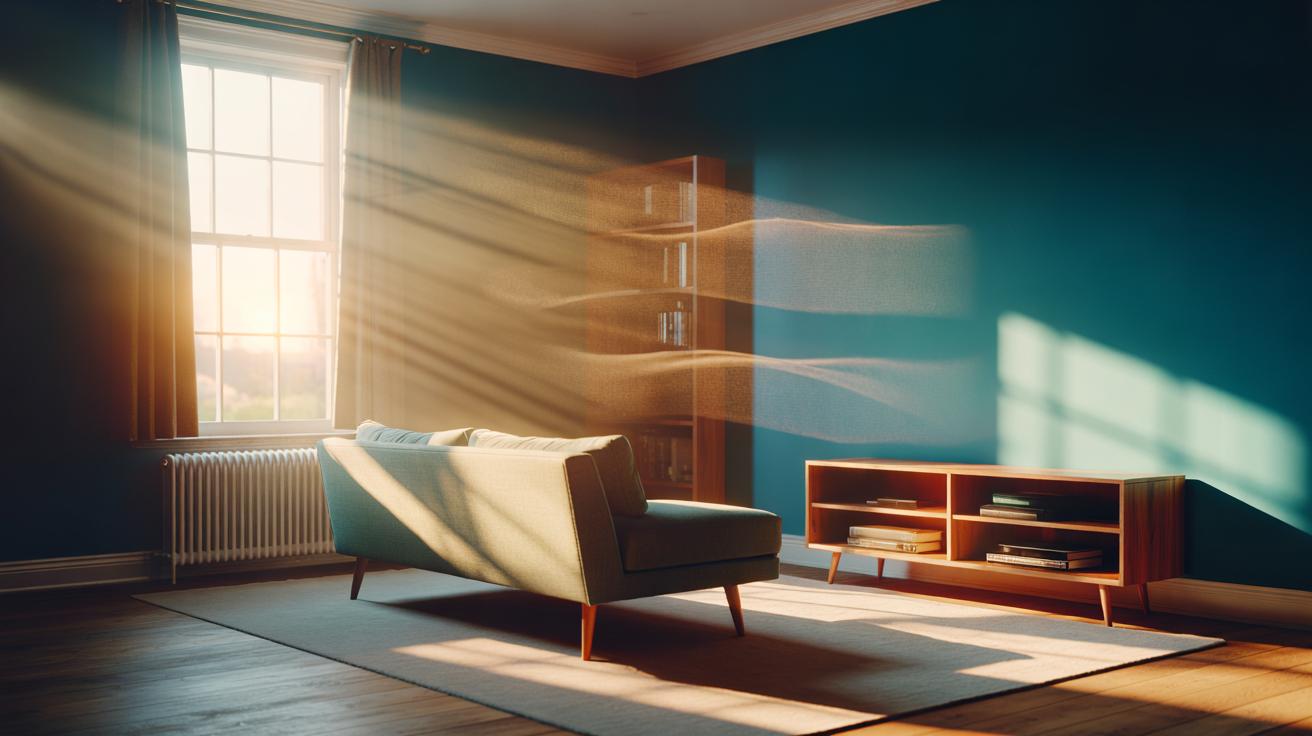
Air behaves predictably indoors. Along walls and floors, a slow-moving boundary layer forms; when furniture hugs that surface, the layer thickens and the room loses vital circulation. Leave gaps and you enable gentle convection loops: warm air from radiators or sunlit windows rises, cooler air slips behind and beneath furnishings, and the cycle continues. Think of these gaps as quiet “ducts” that keep the room mixed without fans. Even a few centimetres allow plumes to form and rejoin the broader flow, preventing cool “dead” corners that feel damp and stale.
British layouts amplify this principle. Radiators under windows rely on rising air to wash the glass and push warmth across the room. A heavy curtain, a bookcase too tight to the skirting, or a sofa directly opposite forms a barricade. Give radiators a clear path and maintain floor clearance under seating, and you’ll reduce stratification, ease draughts by smoothing pressure differences, and help your thermostat reach set-point more evenly. Better mixing often means you feel comfortable at a slightly lower temperature, trimming bills while making dust resuspension less likely.
The Dust Cycle: What Your Furniture Hides
Household dust is a motley mix: skin flakes, fibres, soot from candles or cooking, outdoor particles, and microscopic fragments of soil. It settles fastest where the air is still. Tight furniture arrangements create sheltered eddies that act as deposition zones, especially behind headboards, under low sofas, and along skirting behind wardrobes. In these pockets, humidity can tick up, encouraging dust mites and making particles tackier. Reduce stagnation and you reduce both deposition and the conditions that help dust cling. The result: less build-up between deep cleans and fewer bursts of resuspended particles when you move about.
Spacing also fights the electrostatic “grip” on plastics and varnished panels. Gentle flow dilutes charges and carries fibres onward toward extraction points, whether that’s a HEPA filter, an open window, or a cooker hood drawing air through adjacent rooms. It makes routine cleaning more effective too. A nozzle can reach the back edge of a bookcase if you’ve allowed a modest gap; bed slats breathe if storage boxes aren’t crammed edge to edge. It’s not minimalism for its own sake; it’s targeted clearance where dust would otherwise hide.
Practical Spacing Strategies for Every Room
Start with the basics. Aim for consistent gaps behind large pieces and genuine leg clearance beneath them. Prefer furniture on legs over pieces that run flush to the floor, and keep cable nests from becoming lint traps. In bedrooms, lift duvets away from radiators and allow the headboard to breathe; in living rooms, give sofas and sideboards room to “exhale”. Kitchens benefit from kickboards with vent cut-outs near appliances. Small, deliberate voids guide air like tiny by-passes, keeping surfaces drier and cleaner. Use felt pads or spacers to maintain even separation without constant measuring.
As a rule of thumb, think in centimetres, not metres. The aim is to encourage micro-currents, not redesign the floor plan. Where windows are regularly opened, align furniture to avoid blocking that cross-flow. Where windows stay shut, pair spacing with a quiet purifier to capture the dust you’ve set in motion. The table below offers practical clearances that fit typical UK rooms without stealing usable space.
| Item/Context | Recommended Clearance | Airflow Benefit | Extra Tip |
|---|---|---|---|
| Sofa against wall | 8–10 cm behind; 10–12 cm floor clearance | Maintains convection and prevents dust pockets | Use uniform spacers so the gap doesn’t close over time |
| Bed and headboard | 5–7 cm behind; 10 cm under-bed void | Reduces humidity build-up and mite habitat | Choose slatted bases; avoid solid boxes end-to-end |
| Wardrobe/bookcase | 5 cm behind; 5–8 cm off skirting vents | Prevents still-air traps along vertical surfaces | Open-backed units improve airflow |
| Furniture in front of radiator | 20–30 cm in front; 5 cm above radiator top | Allows warm plume to rise and spread across room | Trim long curtains to sit above radiator |
| Media units and cables | 5–8 cm behind | Limits lint traps and heat build-up | Bundle leads; lift extensions off the floor |
Evidence, Metrics, and Simple Experiments
You don’t need a lab to gauge the effect. A low-cost PM2.5 monitor will show how quickly particle levels fall after vacuuming or cooking. Create a baseline, then pull a sofa 8 cm off the wall and raise it on taller legs; repeat the test. Faster decay times signal better mixing and less re-suspension. A CO₂ sensor can also reveal whether fresh air distributes evenly across seating areas, while an infrared thermometer highlights cold, stagnant patches that spacing can relieve.
Visual checks help. A stick of incense traces whether smoke escapes behind a bookcase or pools and stains the wall. Check dust lines along skirting after two weeks: thinner deposits usually follow improved circulation. Energy monitors add a bonus metric—radiators freed from blockage often heat rooms quicker, shaving minutes off boiler cycles. If you can’t move heavy furniture, add low-friction sliders or breathable panels that create hidden channels. Evidence builds with small trials, telling you where each centimetre does the most work.
Thoughtful furniture spacing doesn’t demand a new aesthetic; it invites your home’s air to perform as designed. By carving tiny pathways for convection and smoothing pressure differences, you choke off stagnant pockets where dust accumulates, cut humidity that nurtures mites, and help heat travel where it’s needed. The pay-off is cleaner surfaces, steadier comfort, and less graft on cleaning day. Start with the bulkiest piece you own, create a gap you can measure, and watch the room breathe easier. Which item will you shift first, and what simple metric—dust on the skirting, PM readings, or quicker warm-up—will you use to judge the change?
Did you like it?4.4/5 (30)