In a nutshell
- 🍾 Use a salt–ice bath (salt + ice + a little water) to create a super-cold brine that chills a 750 ml bottle in ~3 minutes—significantly faster than a freezer thanks to superior conduction and convection, especially when you gently rotate the bottle.
- 🔬 The method works via freezing point depression: salty brine drops to about −7°C to −12°C and, with the ice’s latent heat of fusion, strips heat rapidly from the wine and glass.
- 🧰 How-to: aim for roughly a 1:4 salt-to-ice ratio, add enough water to form a slushy bath up to the bottle’s shoulders, and rotate every 3–5 seconds; target serving temperatures of 8–10°C (whites), 10–12°C (rosé), 12–14°C (light reds).
- ⚠️ Safety and control: set a timer, dry the bottle before opening, avoid using hot glass, and keep sparkling necks above the brine; this method gives more precision and less risk than leaving a bottle in the freezer.
- 🛠️ Troubleshooting & tips: add more salt and a bit more water if it’s slow, use crushed ice for better contact, keep the bottle moving, and consider a metal bucket or initial rock salt boost for extra speed.
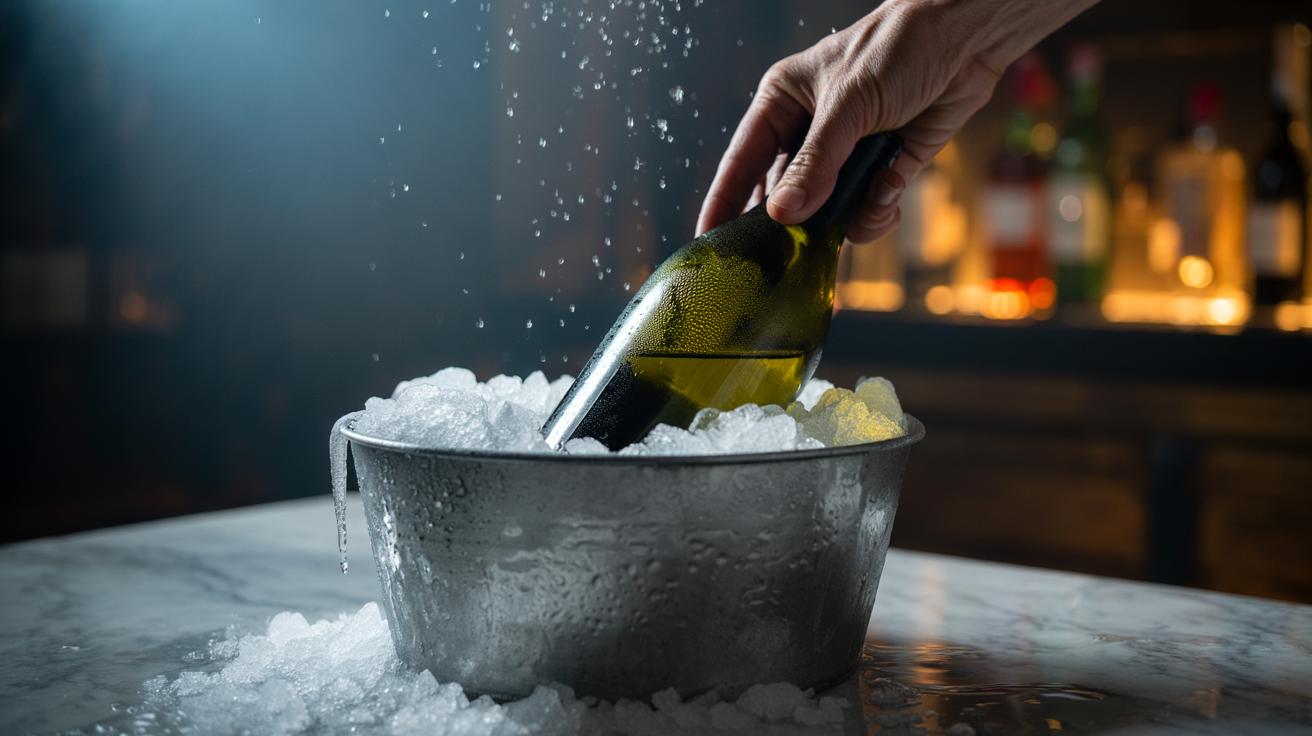
There’s a bartender’s trick that sounds like a parlour game but works with ruthless efficiency: plunge your bottle into a slurry of salt, ice and a little water, and it chills to serving temperature in about three minutes. Where a freezer cools sluggishly with cold air, this method uses a super-cold liquid that clings to the glass and whisks away heat. The result is faster than a freezer, safer than leaving a bottle forgotten on ice, and perfectly repeatable in a home kitchen. Below, we explain why the technique is so effective, the science that powers it, and the precise steps that guarantee crisp whites, lively rosés and party-ready fizz—without cracked glass or frozen wine.
Why Salt and Ice Beat the Freezer
Freezers chill with air, a poor conductor of heat. An ice–salt bath creates a super-cold brine that hugs every contour of the bottle, turbocharging heat transfer by conduction and convection. Add a splash of water to the ice and the bottle is surrounded by liquid, not isolated by air gaps. When you gently rotate the bottle, fresh cold brine continuously sweeps the surface, stripping away warmth at speed. This intimate contact is the secret weapon: it cools a 750 ml bottle of wine in roughly three minutes instead of the 25–40 minutes a freezer needs.
There’s another advantage: control. In a freezer, wine can over-chill at the surface, risking partial freezing and pressure build-up, especially with sparkling bottles. In a salt–ice bath, you can stop exactly at your target—8–10°C for whites, 10–12°C for rosé, 12–16°C for lighter reds—by simply lifting the bottle, giving it a quick wipe, and checking the feel on the neck. Crushed ice accelerates things further by increasing contact area; rock salt or ordinary table salt both do the job.
| Method | Typical Time to Serve | Serving Risk | Best Use |
|---|---|---|---|
| Salt–Ice Bath (agitated) | 3–5 minutes | Low if monitored | Rapid chilling, guests arriving |
| Freezer | 25–40 minutes | Bottle burst/freeze risk | Passive cooling, needs timer |
| Fridge | 90–120 minutes | Very low | Advance planning |
| Wet Towel + Freezer | 10–15 minutes | Moderate | When ice is scarce |
The Science Behind the Super-Chill
The magic rests on freezing point depression. Dissolve salt (sodium chloride) into water and its freezing point drops well below 0°C. In a bath packed with ice and salt, melting ice absorbs huge amounts of heat via the ice’s latent heat of fusion, while the resulting brine can slump to around −7°C to −12°C in a domestic setup. That means your bottle sits in a liquid significantly colder than the ice alone, accelerating the temperature drop dramatically. Because liquid water’s thermal conductivity and convective movement trounce still air, heat escapes the wine swiftly and evenly.
There’s also simple physics at play inside the bottle. Wine’s specific heat is close to water’s, so each degree it cools represents substantial energy leaving the glass. By rotating the bottle, you minimise boundary layers—the thin, insulating film of warmer liquid that clings to surfaces—and maintain a steep temperature gradient. Salt keeps the mixture slushy instead of forming a hard block of ice, so the brine stays mobile and effective. In short: colder medium + better contact + agitation equals a three-minute chill that a freezer’s cold air can’t match.
How to Chill Wine in Three Minutes
Kit: a bucket, large bowl or sink; ice (about 1–2 kg), salt (roughly 200–300 g), cold tap water, a clean tea towel. Fill the vessel halfway with ice, sprinkle on salt at about a 1:4 salt-to-ice ratio by weight, then pour in just enough water to create a thick slush that reaches the bottle’s shoulders. Nestle the bottle fully, then gently rotate it—one full turn every 3–5 seconds. With crushed ice and steady spinning, expect a white wine to hit 9–10°C in around three minutes. Sparkling wine may need 4–6 minutes; pour a tester if you’re uncertain.
Safety and finesse: keep the foil and cork area above the brine if you’re fussy about labels; always dry the bottle before opening for a clean, non-slip grip. Don’t attempt this with hot glass; room-temperature bottles are ideal. For aged reds, aim higher—13–16°C—to preserve aromatics and texture. If you’re short on ice, pre-chill water in the freezer for five minutes and use a little more salt. Do not leave bottles unattended in any cold bath or freezer—set a timer. When you’re done, the brine can de-ice your steps or be poured away responsibly.
Troubleshooting, Myths, and Pro Tips
If it isn’t working quickly, you likely need more salt, more water for liquidity, or more surface contact. A dry pile of cubes insulates; a wet slush conducts. Switch to crushed ice and keep the bottle moving. Thick glass (magnums, some sparkling bottles) cools slower—allow an extra minute. If labels matter, slip on a sleeve or cling film first. Myth-busting: salt doesn’t “freeze” the wine; it lowers the freezing point of the bath, allowing the brine to get colder than plain ice. Freezers aren’t “safer”; they’re riskier if you forget the bottle and it expands on freezing.
Pro tips: add a handful of rock salt early to punch through 0°C quickly, then top up with table salt. Pre-chill clean stones or reusable packs and mix them through the ice to increase thermal mass. Use a metal bucket for marginal gains—metal sheds heat faster than plastic. For parties, keep the brine topped with a few cubes and a pinch of salt between bottles. For the fastest results, submerge up to the neck and rotate consistently. Aim for serving bands: 8–10°C (aromatic whites), 10–12°C (rosé), 12–14°C (Beaujolais, lighter reds), 5–8°C (Prosecco; avoid over-chilling Champagne).
In practice, the salt–ice method is a compact masterclass in kitchen physics: precise, inexpensive and impressively quick. It’s the kind of trick that turns a last-minute bottle into an on-time aperitif and rescues warm supermarket finds before supper. Once you’ve seen a wine plunge from room temperature to crisp and lively in minutes, the freezer starts to look painfully slow. Do you already rely on a brine bath, or will you try this technique the next time guests knock early—and if you do, which ratio and rotation rhythm give you your perfect chill?
Did you like it?4.3/5 (20)