In a nutshell
- 🌟 Reflective flashes from spinning CDs create erratic glare and pattern shifts that overwhelm birds’ motion-sensitive vision, nudging them away from fruit without harm.
- 🛠️ Deploy old CDs at varied heights on light monofilament, hang discs back-to-back, and reposition weekly; combine with selective netting for stubborn raiders.
- 📊 Choose smart deterrent mixes: CDs and holographic tape for quick coverage, netting for high-value crops, and decoys for short-term gaps—aim for layered deterrents to reduce habituation.
- ⚖️ Stay compliant and considerate: UK Wildlife and Countryside Act 1981 permits non-lethal deterrents; avoid dazzling roads or windows and check netting to prevent entanglement.
- 🔄 Expect habituation; rotate layouts, tweak heights, clear fallen fruit, and adjust for weather so the scene stays unpredictable and protection remains effective.
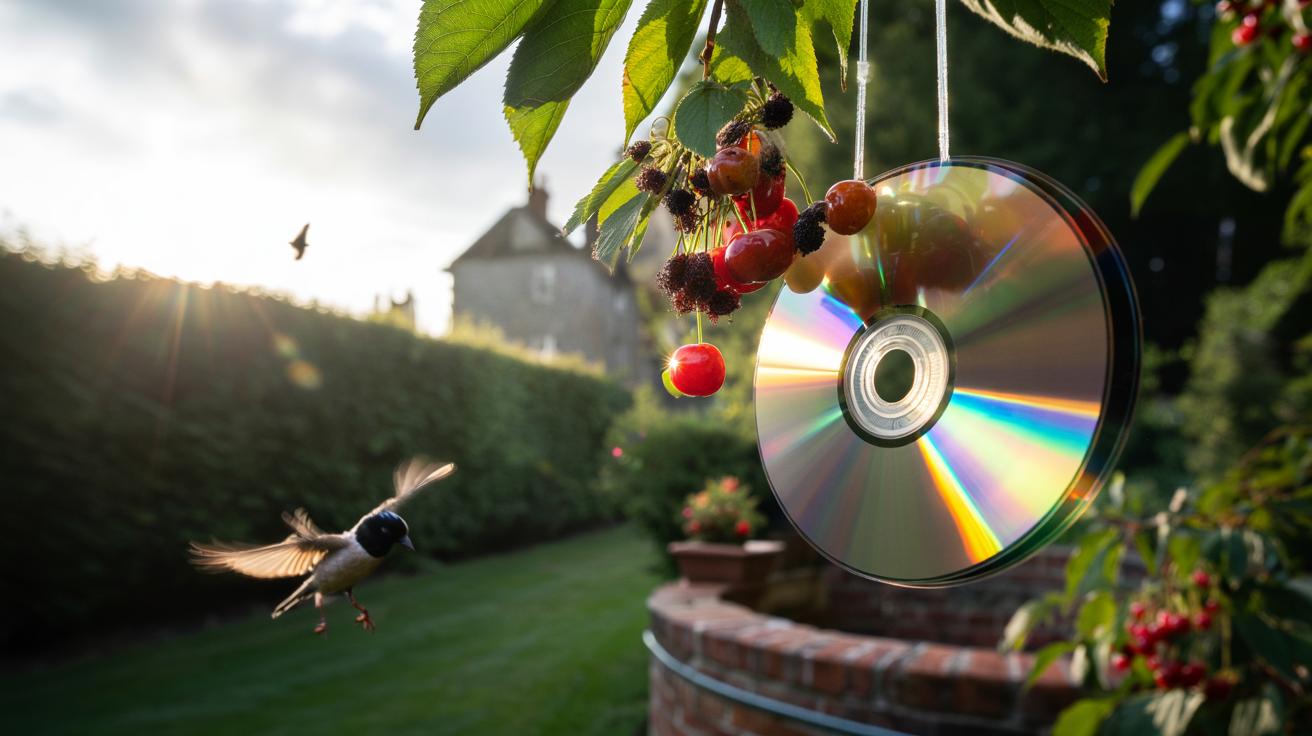
In sheds across Britain, that stack of scratched CDs has found a new encore in the garden. Hung from wires or canes near ripening fruit, the discs throw erratic, brilliant reflective flashes that unsettle birds. It’s low-tech, cheap, and oddly satisfying to watch as the wind spins a silvery guard around cherries, currants, and strawberries. The trick works not by harming wildlife but by overwhelming a bird’s finely tuned visual system with unpredictable glare. Used correctly, old CDs can create a moving light field that discourages pecking without trapping, shocking, or harming a single feather. Here’s how those shimmering circles confuse visitors from dawn till dusk—and how to deploy them without turning your plot into a scrapyard mobile.
Why Reflective Flashes Fool Garden Birds
Birds rely on acute motion detection and high-contrast visual cues to forage while scanning for danger. A spinning CD sends bursts of specular reflections across multiple angles, producing bright, strobing points that shift with wind and sun. For thrushes, blackbirds, pigeons, and starlings, the inconsistent glare looks like activity, not food. Many species also perceive parts of the ultraviolet spectrum; while not all CDs reflect UV strongly, the layered rainbow on their surface adds disruptive patterns. The brain prefers stable scenes for safe feeding; flicker and flare scream “move on.” This sensory overload is enough to push birds towards quieter borders or a neighbour’s lawn—at least for a while.
Consistency kills the effect; unpredictability sustains it. The light bursts vary with clouds, gusts, and canopy gaps, so CDs keep producing new cues through the day. In early mornings, low sun angles create long, skittering flashes across the soil; by midday, the discs beam short, intense points around fruit clusters. Because the stimulus is intermittent and directional, birds struggle to habituate quickly. Pair that with subtle motion and a faint rattle from the strings, and the device masquerades as both sight and sound alarm, all without batteries or chemicals.
How to Deploy Old CDs Around Fruit Trees and Allotments
Think coverage and movement. Suspend CDs on light cord or monofilament at different heights: eye-level for pigeons, lower for blackbirds, higher for raiding corvids. Use the central hole plus a side hole (pierced near the rim) to hang two discs back-to-back; their mirrored faces amplify glare and stop the pair from nesting in the breeze. Aim for a grid of one set per metre along rows, and three or four clusters per young fruit tree. Keep them free to rotate—friction kills flicker. Position away from windows or roads to avoid nuisance reflections, and secure knots to survive a blustery squall.
Refresh the pattern weekly. Shift lines, alter heights, and add a couple of dangling strips of holographic tape for extra sparkle on grey days. In heavy crops, stake a perimeter line and drop CDs inside the canopy as “interceptors” near ripest trusses. They are a deterrent, not a barrier, so combine with discreet netting on the most targeted beds. A small bell can add a surprise note in still weather. If the garden must look tidy, group CDs in neat mobiles; they’ll work as well and keep the aesthetic peace.
What Works Best in British Gardens
The humble CD is not the only option. Here’s a quick comparison to help you match method to crop, budget, and time. Mixing tactics reduces habituation and covers varied weather.
| Method | Typical Cost | Setup Time | Weather Durability | Wildlife Risk | Best Use |
|---|---|---|---|---|---|
| Old CDs | Free–low | Fast | Good; may tangle in gales | Low | Trees, soft fruit rows |
| Holographic tape | Low | Fast | Fair; frays over time | Low | Rows, raised beds |
| Bird netting | Medium | Moderate | High | Moderate if poorly staked | Blueberries, brassicas |
| Decoy owls/scarecrows | Low–medium | Fast | High | Low | Open plots, short term |
For peak protection, layer tactics: reflective deterrents to scatter first arrivals, netting to stop the determined few. Rotate positions every week or two so birds don’t map a safe route. On cloudy, windless days, the effect softens; add motion (spinners) or mild noise to keep the field lively.
Limits, Law, and Neighbour-Friendly Use
All wild birds in the UK are protected under the Wildlife and Countryside Act 1981. Non-lethal deterrence is allowed, but never destroy active nests or harm birds. If netting is used alongside CDs, tension and peg it so no creature can become entangled; check morning and evening. Avoid creating mirror-like dazzle towards roads or bedroom windows; angle lines inward and test at different times of day. Polite notice to neighbours can pre-empt complaints, especially in tightly packed terraces where reflections travel.
Expect diminishing returns if the layout stays static. Habituation is real, particularly with clever corvids. Reboot the pattern before birds solve it: switch CD clusters between trees, change string lengths, and remove a few for two days before reintroducing them elsewhere. In storms, bring mobiles down to stop tangles. Compost-fruit competition matters too—clear fallen cherries and gooseberries, or you’ll lure birds beneath your deterrent array. The goal is discomfort, not conflict: nudge flocks along without turning the garden into a light show.
As a thrifty tactic, the spinning-CD trick earns its place: it’s adaptable, quick, and rooted in how birds actually see. Yet it works best as part of a flexible plan that changes with weather, ripening times, and species. Keep the scene unpredictable and the reward scarce, and your fruit stands a far better chance. Will your next weekend in the garden be the moment you string up a few salvaged discs, tune their sparkle, and test how far a little light can guard your crop—while keeping wildlife safe and welcome at the edges?
Did you like it?4.5/5 (29)