In a nutshell
- 🔥 Mechanism: boiling water delivers acute thermal shock, rupturing cell membranes and causing proteins to denature; tissues die once they exceed about 60°C, and disrupted xylem/phloem starve the plant.
- ☕ Technique: Use a narrow-spout kettle, pour low and steadily onto the crown and stems, wear protective gear, and avoid splashing; test sensitive surfaces and repeat every 7–14 days for persistent perennials.
- 🛑 Limits: It’s primarily a surface-level control; deep-rooted weeds can reshoot, so consider mechanical extraction or a flame weeder for tough species, and pair with joint maintenance to reduce reinfestation.
- ⏱️ Benchmarks: Near 100°C at the kettle (~70–85°C at contact), visible damage in hours with full browning in 24–48 hours, and roughly 5–8 m of narrow joints treated per litre.
- 🌿 Strategy: A residue-free, chemical-free option ideal for small patios and spot jobs; combine with sweeping, drainage fixes, and polymeric sand for longer-lasting, low-impact weed control.
On a British patio riddled with dandelions, chickweed, and moss, the simplest remedy is often hiding in plain sight: a kettle. Pouring boiling water directly on unwanted growths delivers a clean, chemical-free strike that many householders swear by. The method relies on physics and plant anatomy, not pesticides, leaving no residues to track indoors or wash into drains. Applied carefully, heat destroys the weed’s vital tissues almost instantly, collapsing the leaves and stems before the plant has time to respond. Below, we explain the precise science behind the sizzle, how to pour with control and safety, and the situations where hot water shines—or falls short—on British paving and paths.
Why Boiling Water Works on Weeds
Pouring near-100°C water triggers a violent thermal shock that ruptures plant cell membranes. Sudden heat causes the lipid layers to melt and proteins to denature, so cells lose integrity and leak. With membranes compromised, essential processes—photosynthesis, respiration, nutrient transport—fail within moments. The kill happens in seconds once tissues exceed roughly 60°C, but the visible collapse often unfolds over several hours as leaves wilt and darken. The effect is most pronounced on tender annuals and shallow-rooted seedlings, which lack insulating tissues and succumb quickly.
Sturdier perennials are more resilient because underground organs—crowns, rhizomes, and taproots—act as heat refuges. Even so, the exposed parts are blasted, starving the below-ground stores. Repeat scaldings exhaust reserves until regrowth slows or stops. Besides the living cells, the plant’s vascular tissues are disrupted: xylem and phloem heat up, water columns cavitate, and sap flow stalls. Without functioning transport pathways, the weed cannot rebuild leaf area fast enough to recover, especially during dry spells when regrowth is already under stress.
How to Pour Safely and Effectively
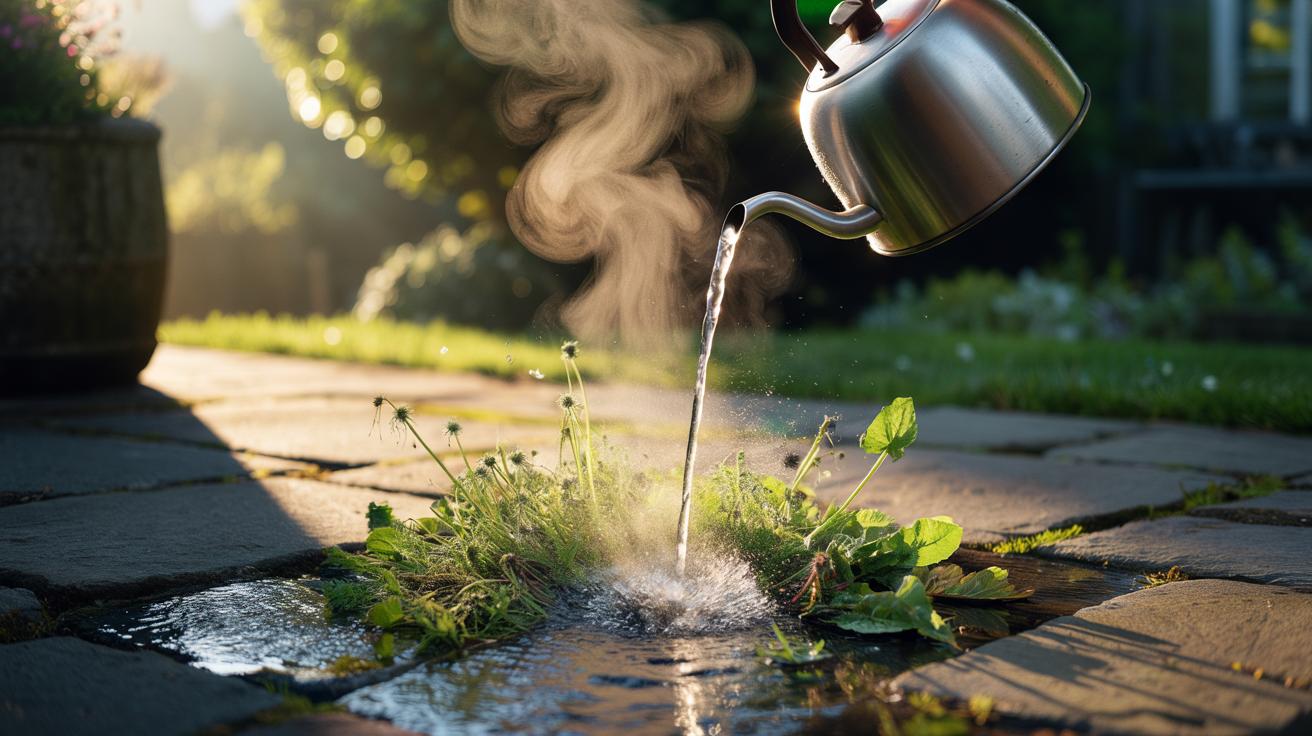
Boil a kettle and move promptly. Use a kettle with a narrow spout or a metal watering can reserved for hot water to control the flow. Start at the crown of the weed and trace the pour along stems and into the joint or crack where roots anchor. Keep the stream low and steady to minimise splashing, and work from the far edge of a patio toward your exit to avoid stepping over freshly scalded surfaces. On thick clumps, pause a moment to let heat penetrate, then make a second pass to reach protected tissue.
Wear covered shoes, long trousers, and heat-resistant gloves. Avoid pouring near delicate ornamentals; hot water will damage any plant it touches. Shield adjacent lawn with a board if runoff is likely. Never attempt this on ice, near pets, or where children are present. On porous stone or cement joints, hot water dissipates efficiently. On resin-bound or newly grouted areas, test a hidden spot first: rapid heating can stress certain materials. Repeat treatments every 7–14 days on persistent perennials until regrowth ceases.
Limits, Risks, and When to Choose Another Method
Boiling water is a surface-level control. Deep-rooted species—plantains, dock, established dandelions—may reshoot if the crown remains insulated. Seeds lodged in joints are untouched until they germinate. Expect reliable top kill, not always total eradication. In gravel, heat dissipates quickly; raking and a subsequent scald usually work best. Where weeds are entwined with moss in damp, shaded corners, a sequence—scrape, scald, sweep—reduces both biomass and spores. For large paved areas, the method becomes labour-intensive; a propane flame weeder or dense planting to outcompete weeds may be more practical.
Risk management matters. Scalds are an obvious hazard. Some pavers, especially dark-coloured composites, can show temporary thermal discolouration if drenched repeatedly. Avoid run-off into beds with shallow roots of prized plants. Do not pour onto electrical covers, polymer edging, or newly laid resin surfaces. If you need long-lasting prevention, combine hot-water spot treatment with sand joint maintenance, good drainage, and physical exclusion such as joint stabilisers or polymeric sand. Where bindweed or bramble intrudes, mechanical extraction or targeted systemic control is typically more efficient.
Quick Reference: Temperature, Timing, and Coverage
Heat effectiveness follows a simple rule: hotter and quicker is better. Water leaves the kettle near 100°C but cools rapidly in air and on contact. Keep the spout close to the target to maintain lethal temperatures on the leaf and crown. On a breezy day, smaller, repeated pours outperform one splashy deluge. Early growth stages are the easiest times to win; the tender tissues of spring seedlings and post-mowing resprouts are highly susceptible. After treatment, expect visible collapse within hours and full browning within one to two days.
Plan your session with practical benchmarks. One litre treats several small weeds or a few metres of joints if applied deliberately. Combine with sweeping to remove dead material and expose any survivors for a follow-up pass. Two or three well-timed treatments typically outcompete the root reserves of most paving weeds. Where reinfestation is chronic, improve joint fill, fix drainage, and reduce light in cracks to slow germination. Use the guidelines below as a starting point.
| Parameter | Guideline |
|---|---|
| Water temperature at pour | Near 100°C from kettle; expect ~70–85°C at contact with quick, close pouring |
| Time to visible damage | Minutes to hours; full browning in 24–48 hours |
| Repeat interval | Every 7–14 days for perennials or until regrowth stops |
| Coverage per litre | Approx. 5–8 linear metres of narrow joints, depending on pour control |
| Best targets | Seedlings, annuals, shallow-rooted weeds on hardstanding |
Used judiciously, boiling water is a tidy, residue-free way to keep patios and paths clear, relying on physics rather than herbicides. It fits small spaces, spot jobs, and eco-conscious routines, especially when combined with simple prevention like tight jointing and regular sweeping. The key is precision: make each pour count, follow up on stubborn crowns, and protect what you want to keep. As our summers trend warmer and hosepipe rules tighten, will you build a repeatable, safe hot-water routine—or blend it with other low-impact tactics to create a patio maintenance plan that suits your space and time?
Did you like it?4.6/5 (23)