In a nutshell
- 💧 How it works: evaporation boosts leaf-level relative humidity and lowers VPD to protect stomata; keep pots on stones with the base above the waterline for a safe, steady microclimate.
- 🧰 Setup essentials: choose a wide, shallow tray, rinse pebbles, and position away from radiators or draughts; group plants and track results with a leaf-height hygrometer—more surface area equals more evaporation.
- 🌿 Gains and limits: expect a local +5–15% RH lift that helps ferns, calatheas, orchids, and philodendrons; it’s not a whole-room fix, and very dry homes may need a humidifier; succulents and cacti prefer dry air.
- 🧽 Maintenance and hygiene: top up with rain/filtered water to curb limescale, scrub weekly to remove biofilm, and avoid additives (oils, bleach, fertiliser); tackle algae or gnats by emptying and drying the tray.
- 🔄 Seasonal strategy: scale the tray in winter, rotate pots so foliage doesn’t seal the surface, and balance airflow; misting causes short spikes, while pebble trays deliver stable, targeted humidity.
When central heating clicks on and windows stay sealed, indoor air turns parched. Many tropical houseplants—raised by cloud forests and monsoon breezes—struggle when the air dries out, showing crisped leaf edges and stalled growth. A simple, low-tech fix sits on thousands of British windowsills: the pebble tray. By harnessing gentle evaporation, this shallow bed of stones and water raises relative humidity right where leaves breathe, creating a stable microclimate without soaking soil or fogging the room. It’s a passive, affordable tactic that complements good light, watering, and feeding, and it works silently day and night. Here’s how to set it up, the science behind it, and what results to expect in a typical UK home.
How a Pebble Tray Works
The principle is elegantly simple. Water held beneath a pot evaporates, using heat from the room to shift liquid into vapour. That vapour accumulates in the still air just above the tray—the leaf-level boundary layer—nudging up local relative humidity. More exposed water surface means more evaporation, so a wide tray packed with stones (not submerged) performs better than a narrow saucer. The effect is concentrated within a few centimetres, exactly where stomata regulate a plant’s water loss and gas exchange. By lowering vapour pressure deficit (VPD) near foliage, leaves retain moisture and can photosynthesise efficiently.
Unlike misting, which causes a brief spike and wet leaves, a pebble tray delivers a steady trickle of humidity without encouraging leaf-spot fungi. It will not transform a sitting room into a jungle, but it can lift humidity around sensitive plants by a useful margin. Keep the waterline below the pot base so roots never sit in standing water, and ensure the pot rests on stones, not the tray’s floor. Think of it as targeted comfort, not a whole-room solution.
Setting Up the Tray Step by Step
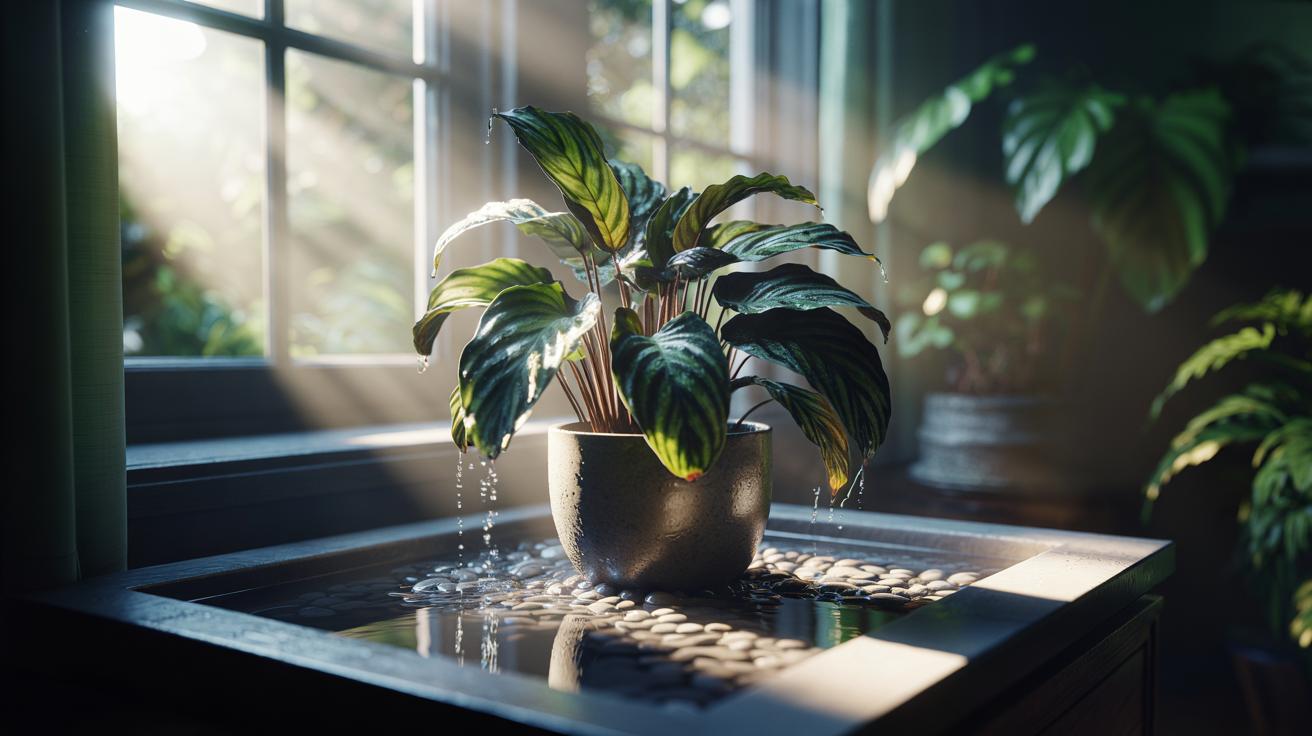
Choose a shallow, rigid tray—ceramic, glazed terracotta, or metal—roughly wider than your pot canopy. Rinse a bag of inert stones or aquarium-grade gravel to remove dust, then pile them to create a stable platform. Pour in water until it sits just shy of the stone tops; place the pot so its drainage holes are fully above the waterline. Add pot feet if needed to gain a few millimetres of clearance. Grouping several plants around one tray increases the moisture “bubble” and looks tidy on a windowsill or console.
Position matters. Set trays away from radiators and draughty doors; airflow is good, but a constant breeze strips humidity. Top up with rainwater or filtered water to reduce white limescale deposits. A small digital hygrometer at leaf height will tell you what the plant actually “feels.” As a rule of thumb, a bigger water surface equals a stronger effect, but don’t crowd leaves so tightly that air cannot move—stagnant air invites disease. Reassess with the seasons; summer warmth accelerates evaporation, while winter heat can demand larger or multiple trays.
What Gains to Expect and When It Falls Short
In a typical UK living room sitting at 30–40 per cent RH, a wide pebble tray can raise humidity at leaf level by 5–15 per cent, depending on temperature, ventilation, and plant grouping. That modest lift is often enough to calm ferns, calatheas, orchids, and young philodendrons, easing brown edges and improving turgour. You’re smoothing day–night swings too, which helps buds set and leaves unfurl cleanly. Think of the tray as shaving the VPD peak during heated afternoons and radiative nights—small moves that add up to healthier growth.
There are limits. In very dry flats (sub‑30 per cent RH), rooms with mechanical ventilation, or open-plan spaces with constant air movement, trays struggle; a powered humidifier or terrarium may be needed. Succulents and cacti don’t want extra humidity at all. Watch for algae film or fungus gnats if water sits stagnant; regular rinsing fixes it. Remember: a pebble tray affects a micro-zone, not the whole room—set expectations accordingly.
| Plant Group | Ideal RH | Typical Tray Gain (at 20°C) | Notes |
|---|---|---|---|
| Ferns (e.g., Boston, maidenhair) | 60–80% | +8–15% | Evaporation helps keep fronds supple; avoid draughts. |
| Calatheas/Prayer plants | 50–70% | +5–12% | Reduces edge crisping; pair with consistent watering. |
| Phalaenopsis orchids | 50–70% | +5–10% | Stable humidity supports spikes and blooms. |
| Philodendrons/Monsteras | 40–60% | +4–8% | Encourages larger leaves and cleaner splits. |
| Succulents/Cacti | 30–40% | Not needed | Prefer dry air; avoid added humidity. |
Maintenance, Water Quality, and Hygiene
Top up as the water recedes; in summer you may refill every day or two, in winter every few days. Using rainwater, deionised, or filtered water reduces limescale crust on stones and glass. Every week, tip out water, scrub stones to break up biofilm, and rinse the tray. A splash of white vinegar helps dissolve deposits; finish with a clear-water rinse. Do not add essential oils, bleach, or fertiliser to the tray—volatile compounds and salts can harm leaves and lungs. If you see mosquito wigglers, empty and dry the tray for 24 hours, then reset.
Adjust the footprint with the seasons. A larger, shallower tray boosts surface area in winter, when heated air is driest. Rotate pots so foliage doesn’t seal the surface like a lid. If hard water is a constant, consider darker stones that hide scale, or swap in aquarium gravel that cleans easily. Keep the approach simple: consistent topping-up, a quick weekly scrub, and periodic deep cleans will keep humidity smooth and the set‑up presentable.
The pebble-tray method succeeds because it allies basic physics with plant physiology, lifting humidity precisely where leaves need relief while keeping compost properly aerated. It’s quiet, cheap, and customisable: scale up for a fern table, or tuck a neat dish under a demanding orchid. Pair it with steady watering, bright but gentle light, and a watchful eye, and you’ve recreated a slice of rainforest nuance on a domestic windowsill. For the cost of a bag of stones, you can change a plant’s daily comfort. Which of your tropicals will you treat first, and how will you tailor the tray to its native habitat?
Did you like it?4.5/5 (26)