In a nutshell
- 🌱 Through imbibition, seeds rehydrate, membranes repair, and metabolism restarts as ABA falls and GA rises, leading to faster, more uniform germination.
- 🛡️ Soaking softens the seed coat (testa), opens the micropyle, and improves oxygen diffusion, making radicle emergence easier—use shallow, aerated containers.
- 💧 Water exposure leaches chemical inhibitors and activates enzymes like alpha‑amylase, proteases, and lipases—essentially low‑tech hydropriming.
- ⏱️ Practical rules: most seeds soak 6–12 hours, very hard coats up to 24 hours; use hand‑warm water and consider scarification for species like lupin or morning glory; avoid soaking tiny mucilaginous seeds (e.g., basil, lettuce).
- 🧪 Post‑soak, drain and sow into a well‑aerated medium; don’t exceed ~24 hours to prevent hypoxia and rot; run side‑by‑side tests to verify the benefit in your conditions.
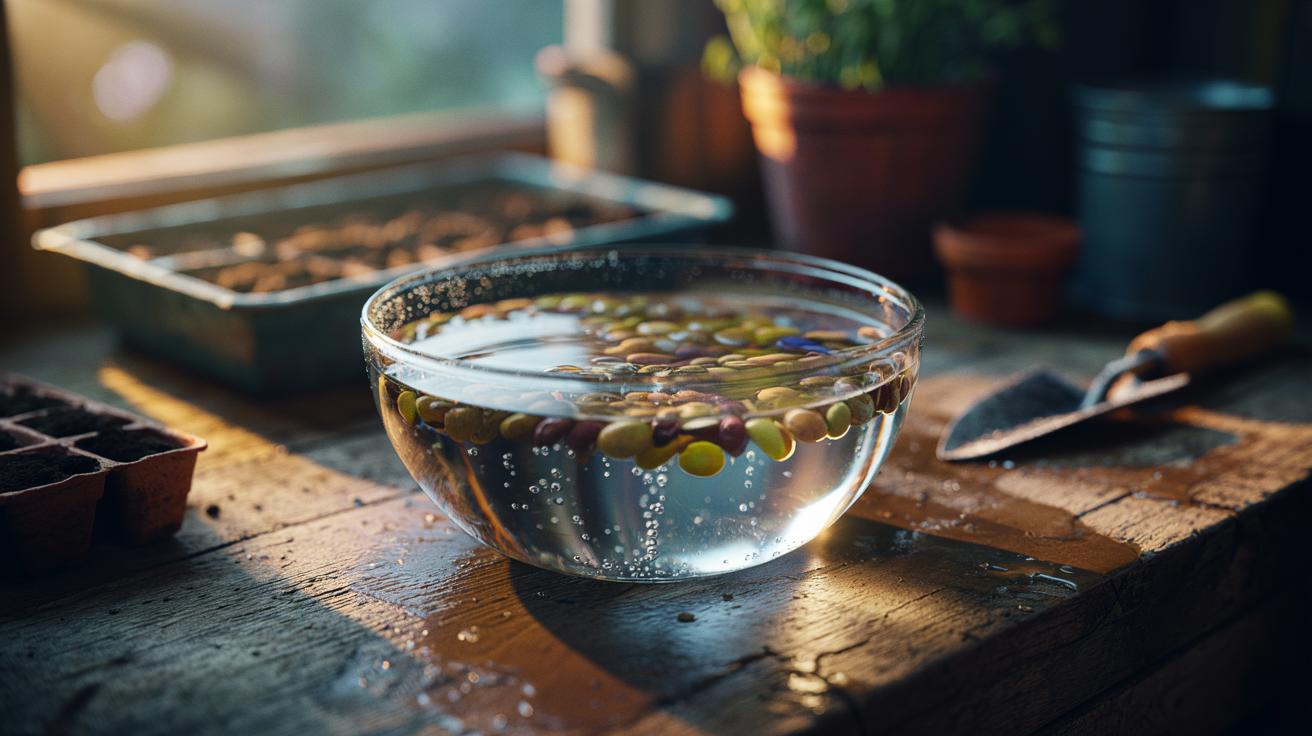
Soaking seeds overnight is a simple trick with serious science behind it. Gardeners swear by it because it often cuts days off waiting time, evens out patchy beds, and lifts germination rates in tricky species. Inside every dry seed lies a sleeping embryo, held in check by tough coats and chemical brakes. Add water and the biological machinery stirs. Cellular membranes reseal, enzymes switch on, and stored food begins to flow. Done well, soaking shortens the starting line. Done badly, it drowns the race. Here’s why it works, when to use it, and how to get the most from those tiny powerhouses.
Hydration and the Science of Seed Dormancy
At the heart of soaking is imbibition, the rapid uptake of water driven by differences in water potential. Dry cells rehydrate, the membranes around organelles repair, and mitochondria reboot to make ATP. This biochemical restart is the prelude to growth: respiration rises, the embryo resumes metabolism, and the first cell divisions kick off. In the dry state, seeds are on pause; water is the unpause button. Hydration also swells tissues, building pressure against the seed coat and setting up the first crack through which the radicle can push.
Hormonal signals pivot with moisture. The brake, abscisic acid (ABA), wanes; the accelerator, gibberellins (GA), increases. That shift triggers gene expression for enzymes that digest stored starch and protein into usable fuel. Soaking is not magic; it’s physiology on fast‑forward. In many species, even 6–12 hours of water access advances this cascade substantially, meaning the moment a soaked seed meets soil, it’s already primed to emerge sooner and more uniformly than a dry counterpart.
Softening the Seed Coat and Oxygen Exchange
For many plants, especially legumes and ornamentals with hard coats, the problem is mechanical. The testa can be impermeable, blocking water and gases alike. Soaking softens pectins and relaxes cell walls in the coat, enlarging the micropyle and microfissures that act as gateways. As the coat hydrates, resistance drops. The embryo’s growing radicle can then pierce through with less force, accelerating visible germination. Oxygen diffusion also improves as the coat’s barriers loosen, feeding the aerobic respiration that powers early growth.
There’s a balance to strike. Seeds respire faster when warm and wet, so they need oxygen as much as water. Deep, stagnant bowls can become hypoxic, slowing or killing the very processes you’re trying to accelerate. Use a shallow dish, don’t pile seeds thickly, and refresh the water if it clouds. Hand‑warm water speeds imbibition; hot water cooks embryos. Think of soaking as moist aeration, not submersion without air. Aim for warmth, cleanliness, and room for air to access the water surface.
Leaching Inhibitors and Priming Enzymes
Many species pack their coats with chemical germination inhibitors—residues of ABA, phenolics, and other compounds evolved to delay sprouting until conditions are safe. Soaking leaches these molecules into the water, literally washing away some of dormancy’s chemistry. You’ll often see the soak water tint slightly; that’s a visible hint of diffusion doing its job. In species like beets and parsley, this rinsing can make the difference between weeks of sulking and a prompt, tidy emergence.
The water pulse also jump‑starts enzyme activation in the aleurone layer and embryo. Alpha‑amylase frees sugars from starch; proteases and lipases mobilise proteins and oils. The result is a flush of soluble energy that shortens the lag before cell expansion and radicle protrusion. This is essentially low‑tech hydropriming. Keep it clean: start with potable water, change it once for longer soaks, and drain immediately when time is up to avoid microbial growth. Soak, then sow or surface‑dry and sow—don’t leave seeds stewing.
Practical Guidelines: Soak Times, Temperatures, and Exceptions
Most garden seeds respond to 6–12 hours; tougher coats can need up to 24. Beyond that, risks rise quickly. Warmer water (around room temperature to hand‑warm) accelerates uptake without stressing tissues. Tiny or mucilaginous seeds—think lettuce and basil—often fare worse when soaked; better to mist or use a damp paper pre‑sprout. If you’re dealing with very hard coats (morning glory, lupin), light scarification—a nick with a nail file—paired with a shorter soak can be transformative. Never exceed about 24 hours: prolonged soaks starve seeds of oxygen and invite rot.
| Seed | Typical Soak Time | Notes |
|---|---|---|
| Peas/Beans | 6–12 hours | Speeds swelling; avoid splitting by keeping water just warm. |
| Beet/Chard | 8–12 hours | Leaches inhibitors in the seedball; improves uniformity. |
| Coriander | 8–12 hours | Gently crush schizocarps first for faster uptake. |
| Spinach | 6–8 hours | Cool water preferred; warm can reduce viability. |
| Chilli/Pepper | 8–24 hours | Add warmth after soaking; optional mild chamomile rinse for hygiene. |
| Squash/Pumpkin | 4–8 hours | Short soaks suffice; sow into warm, well‑aerated media. |
| Parsley | 12–24 hours | Stubborn germinator; change water once during longer soak. |
Drain thoroughly, then sow while seeds are plump, or surface‑dry for an hour so they handle cleanly. Rinse after soaking to remove any leached inhibitors clinging to the coat. Provide warmth and consistent moisture in a medium that breathes; a saturated, airless compost undoes the gains of soaking. If in doubt, run a side‑by‑side test with and without a soak. The most convincing data is the tray in front of you.
In short, soaking works because it removes bottlenecks: it hydrates tissues, relaxes hard coats, washes out chemical brakes, and primes the enzymatic engine that powers emergence. It’s a modest intervention with outsized returns when matched to the right species and handled with a light touch. Water is the signal that transforms a seed from storage to life in motion. What will you try first—peas for speed, parsley for proof, or a comparative trial to see which of your favourites respond best to an overnight soak?
Did you like it?4.4/5 (29)