In a nutshell
- 🧪 The chemistry: mildly alkaline water (pH ~8–8.3) from baking soda triggers light saponification and softens Maillard polymers, so burnt residue releases with minimal scrubbing.
- 🥣 The method: use 1–2 tbsp baking soda per litre of very hot water; soak 30–60 minutes (optional low simmer for stainless/enamel), then gentle scraping, a quick wash, rinse, and dry.
- 🛡️ Materials matter: stainless, enamel, glass/ceramic handle full soaks; shorten for aluminium, avoid soaking seasoned cast iron (re-season after paste clean), and be gentle with nonstick—no abrasives or boiling.
- 🔄 Smart pairing: complete the alkaline clean first, then use an acid rinse (vinegar or citric) for limescale; do not mix vinegar with bicarbonate during the soak.
- ✨ Outcome and care: less effort and wear, longer pan life; for stubborn spots use a brief baking-soda paste, then rinse and dry promptly to prevent water marks.
It’s the quiet kitchen miracle: a simple baking soda soak can make a blackened pan look serviceable again without scouring your wrists raw. This home chemistry works because sodium bicarbonate creates alkaline water that loosens stubborn residues where normal washing fails. In hot water, the solution slips under polymerised oils, emulsifies greasy films, and nudges brittle carbon to release. No fancy kit, no harsh fumes—just pantry science. When used correctly, this soak clears the worst burnt-on grime while preserving the finish of your cookware. Below, we unpack why the method works, how to do it step by step, and which surfaces need extra care. You’ll also find strategies for teaming bicarbonate with compatible helpers for especially stubborn stains.
Why Alkaline Water Breaks Down Burnt-On Grime
The magic lies in pH and patience. Dissolved sodium bicarbonate lifts water’s pH to around 8–8.3, creating a mildly alkaline bath. That matters because burnt-on residue usually contains crosslinked fats and sugars. In an alkaline environment, fatty acids begin to form their sodium salts—tiny acts of saponification—which behave like soap, loosening the matrix that binds grime to metal. Hot water accelerates the process by expanding microscopic gaps between residue and surface, allowing the solution to creep in.
There’s a second benefit. Many browned layers are built from Maillard polymers, complex, sticky compounds formed by heat. Alkalinity nudges some of those bonds toward hydrolysis, softening the mass so it flakes with minimal effort. Meanwhile, the faint abrasiveness of undissolved crystals gives a gentle mechanical boost during the final wipe. This is a chemistry-led clean, not a brute-force scrub. Because it’s buffered, bicarbonate remains kinder to finishes than strong alkalis, offering power with control for stainless steel, enamel, and glass.
Step-by-Step: The Baking Soda Soak That Saves Pans
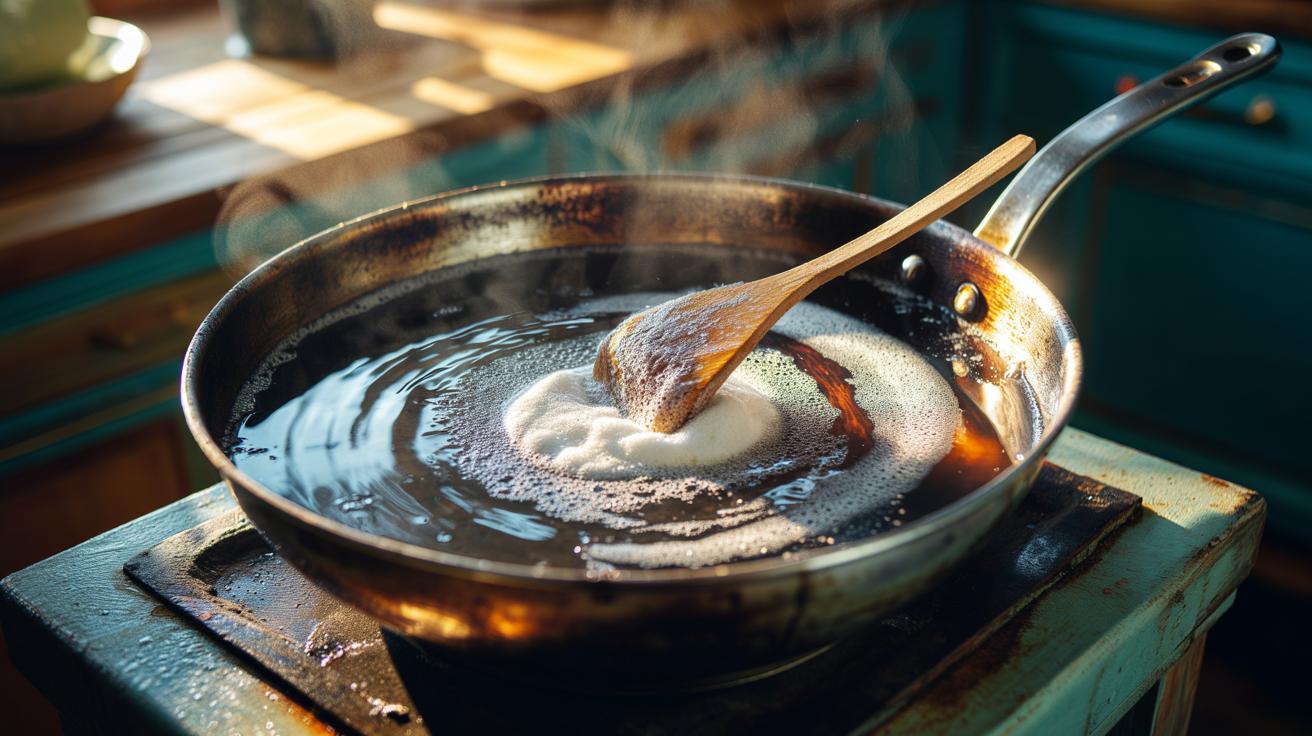
Start with the simplest ratio: add 1–2 tablespoons of baking soda per litre of very hot water. For deep pans, mix directly inside the cookware; for flat sheets, use a roasting tin or sink. Bring to a bare simmer on the hob for stainless steel or enameled pans (optional but effective), or pour in freshly boiled kettle water and cover. Leave 30–60 minutes; for severe charring, extend to 90 minutes. The soak should do most of the heavy lifting before you ever pick up a scraper.
After soaking, use a wooden spatula, nylon scraper, or a soft sponge to nudge residue free—it should slough off in sheets. Refresh with a teaspoon more baking soda and hot water for a second round if needed. Finish by washing with a drop of dish soap, then rinse thoroughly. For final brightening on stainless or glass, rub a quick paste (1 teaspoon baking soda + a splash of water), then rinse and dry. On nonstick, skip simmering; use hot-but-not-boiling water and a soft sponge only.
Material-Specific Tips and Safety Notes
Not every surface loves long alkaline soaks. Match the method to the material to avoid dulling or damage. Stainless steel, enameled cast iron, borosilicate glass, and ceramic generally tolerate the full routine. Uncoated aluminum can dull with lengthy exposure; use shorter soaks and rinse promptly. Seasoned cast iron is a special case—the soak can undercut the seasoning—so use a paste and quick scrub, then re-oil and heat to reseal. For nonstick, avoid abrasives entirely and keep tools gentle.
| Material | Soak Time | Notes |
|---|---|---|
| Stainless Steel | 30–60 min; optional low simmer | Very effective; finish with a light paste if needed. |
| Enameled Cast Iron | 30–60 min | Safe; avoid metal scrapers to protect enamel gloss. |
| Uncoated Aluminum | 15–30 min | Rinse immediately; prolonged soaks may dull the surface. |
| Seasoned Cast Iron | Avoid soaking | Use a paste; re-season after cleaning. |
| Nonstick (PTFE/Ceramic) | 20–30 min, no simmer | Soft sponge only; no abrasives or sharp tools. |
| Glass/Ceramic | 30–60 min | Excellent results; low risk of scratching. |
When to Combine Baking Soda With Other Helpers
Some residues are mixed: greasy polymer on top, mineral scale beneath. Pair your bicarbonate soak strategically without canceling its effect. Avoid mixing vinegar directly into baking soda during the soak—the fizz is satisfying but neutralises the alkali. Instead, complete the alkaline clean first, rinse, then use a brief acid rinse (white vinegar or citric acid) to dissolve any limescale halo left by hard water. Think sequence, not cocktail: alkaline for fats, acid for minerals.
For persistent brown lacquer on sheet pans and stainless, a paste of baking soda with a little hydrogen peroxide can help; apply, wait 10–20 minutes, wipe gently, then rinse thoroughly. Test first on anodised or decorative finishes. A pinch of table salt adds safe abrasion where allowed. Dish soap can join either step, boosting emulsification. If burnt sugar is the culprit, repeat the soak with fresh hot water; once softened, it releases quickly. Always finish by drying promptly to avoid water spots.
In the end, the humble bicarbonate soak delivers a rare blend of thrift and effectiveness: chemistry that respects your cookware and your time. By exploiting alkalinity to nudge fats toward soap and soften browned polymers, it turns dreaded scrubbing into a tidy rinse-and-wipe operation. Adjust the heat, time, and tools to the pan in front of you, and reserve abrasives for last resort. The result is less effort, less wear, and a longer life for your pans. Which pan in your cupboard deserves a second chance—and how will you tailor the soak to bring it back to life?
Did you like it?4.4/5 (25)