In a nutshell
- 🧪 Charcoal’s porous structure enables adsorption of water vapour, lowering relative humidity (RH) in toolboxes and slowing rust.
- 🧰 Choose activated charcoal or clean lump wood; avoid briquettes with additives; use breathable pouches to minimise dust on precision parts.
- 📏 Practical sizing: about 2 g per litre of internal volume, with typical refresh intervals of 3–10 weeks depending on climate and lid openings.
- ♻️ Safe regeneration: dry pouches at 120–150°C or in warm air; never microwave and never heat solvent‑soaked carbon.
- 🧩 Layered defence: pair charcoal with wax/oil films, VCI paper, and a hygrometer to maintain RH around 40–50%.
It’s the quietest defender in a damp shed: a handful of charcoal tucked into a toolbox that keeps steel bright and edges keen. UK garages and vans see wild swings in relative humidity, and that moisture film is exactly what feeds rust. Slip in the right carbon and the air gets drier, corrosive vapours are captured, and oxidation simply slows to a crawl. The idea sounds old-fashioned, but its science is resolutely modern. By providing vast surface area in a small pouch, charcoal traps water molecules before they reach your tools. Here’s how it works, which type to choose, and the simple routine that makes this budget desiccant a long-term ally.
Why Charcoal Stops Rust in Its Tracks
Charcoal—especially the activated kind—is a maze of microscopic pores. Those pores create extraordinary surface area that excels at adsorption (molecules sticking to a surface), not absorption (soaking in). Rust begins when a thin moisture film forms on metal, allowing oxygen and electrolytes to drive electrochemical reactions. Keep the air in your toolbox below roughly 50% relative humidity, and corrosion rates fall dramatically. Charcoal does this silently by binding water vapour and even grabbing acidic gases from cutting fluids, road salt mist, or coastal air that would otherwise accelerate pitting.
In practice, the effect is twofold: the vapour pressure inside the box drops, and aggressive contaminants are intercepted. Unlike open trays of desiccant crystals, carbon doesn’t liquefy or spill when saturated. Its capacity depends on pore structure and ambient conditions, but for most UK workshops a modest sachet can hold RH in the safe zone for weeks. It’s a passive climate control that travels with your tools.
Choosing the Right Charcoal for Your Toolbox
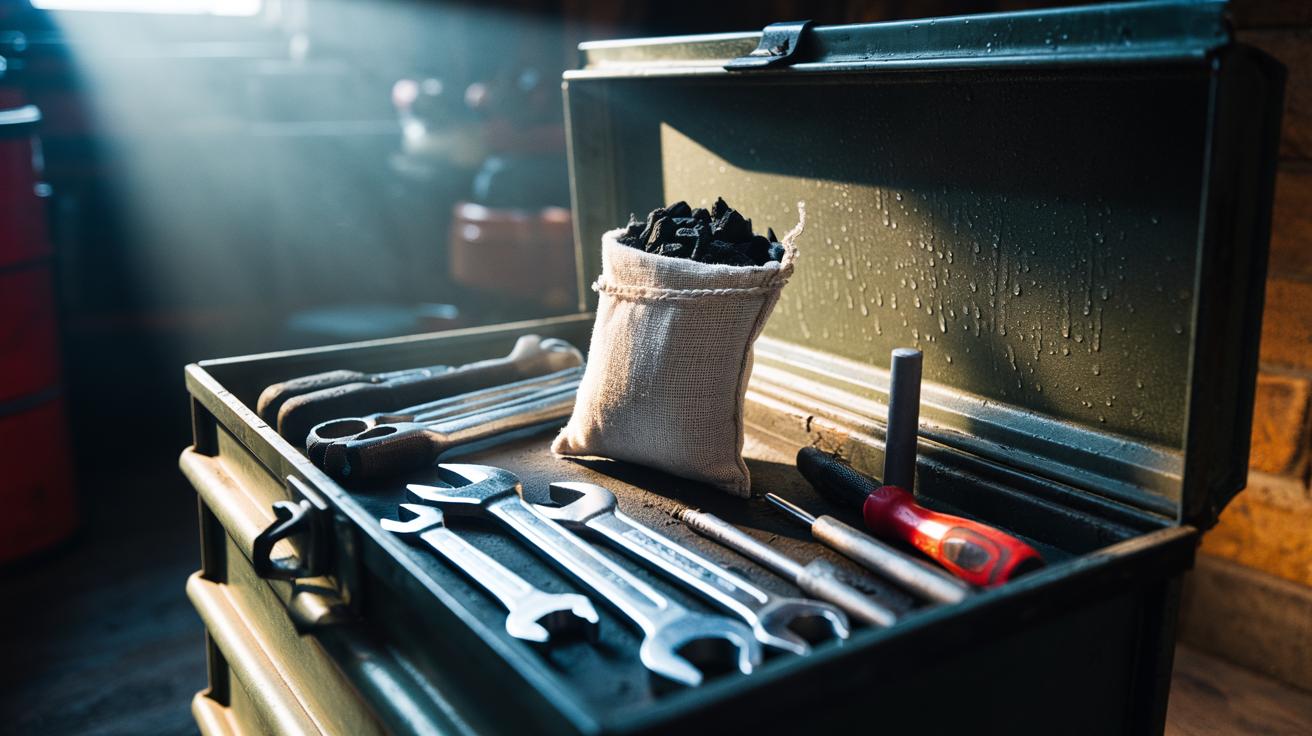
Not all carbon is equal. Pick activated charcoal (sold for aquariums, air purifiers, or deodorisers) or clean lump wood charcoal with no additives. Avoid barbecue briquettes containing binders, nitrates, or lighter-fluid residues; they can off‑gas and stain metal. The best format is a breathable sachet made from paper, muslin, or a coffee filter, sealed well to keep dust out of hinges and bearings. For a typical steel or plastic box, a practical rule is about 2 g of carbon per litre of internal volume, adjusted for the local climate and how often the lid is opened.
Use these ballpark figures to size your sachets and set expectations. Capacity and intervals vary with season, location, and workload.
| Toolbox Size (litres) | Recommended Charcoal (g) | Typical Refresh Interval |
|---|---|---|
| 10 L | 20 g | 3–6 weeks |
| 25 L | 50 g | 3–8 weeks |
| 50 L | 100 g | 4–10 weeks |
How to Use and Regenerate It Safely
Pre‑dry new carbon in a low oven (120–150°C, 60–90 minutes) to drive off factory moisture, then cool and seal it in a breathable pouch. Place sachets high in the box—moist air rises as the interior warms—avoiding direct contact with precision faces to prevent dust transfer. Two or three smaller sachets beat one large pad, creating more even air handling across drawers and compartments. Never heat solvent‑soaked carbon in an oven; dispose of it responsibly.
To regenerate, bake the sachets again at 120–150°C for an hour or two, or leave them on a sunny windowsill or an airing cupboard for a day. Do not microwave. If you work with cutting oils or brake cleaner, rotate sachets more frequently, as charcoal will prioritise organic vapours. Keep oily rags in a separate, lidded container. For best results, pair carbon with tidy storage: wipe tools dry after use and shut the box promptly to trap the conditioned air.
Limitations, Myths, and Smart Combinations
“Prevents rust forever” is a punchy claim, but the truth is pragmatic: charcoal provides ongoing moisture control as long as you maintain it. It won’t reverse corrosion or excuse neglect, yet it reliably holds RH in the safe zone and mops up corrosive vapours. Activated carbon also curbs odours and acidic by‑products, giving delicate alloys a gentler microclimate. Be wary of briquettes marketed for barbecues—binders and accelerants can introduce contaminants. Dust control matters too, so double‑bag fine carbons in filter paper to keep mechanisms grit‑free.
Combine defences intelligently. A light film of wax or tool oil on bare steel, a sheet of VCI (vapour corrosion inhibitor) paper in the drawer, and a sachet of charcoal give layered protection at minimal cost. In coastal or unheated spaces, add a tiny digital hygrometer; seeing 40–50% RH confirms your setup is working. When the number creeps up, regenerate the carbon and carry on.
Charcoal earns its keep because it’s cheap, refillable, and quietly effective at protecting metal from the UK’s damp swings. Tucked into drawers and cases, it lowers humidity and traps aggressive vapours without fuss, provided you size, bag, and refresh it on a simple schedule. Pair it with good housekeeping—dry tools, light protective films, closed lids—and you build a resilient barrier against corrosion. Think of it as a portable micro‑climate for sharp edges and shiny faces. How will you tailor a charcoal setup for your own kit—one big sachet, several small pouches, or a mix alongside VCI and a hygrometer to confirm the sweet spot?
Did you like it?4.5/5 (25)