In a nutshell
- 🧪 Salt boosts laundry chemistry by increasing ionic strength, forming larger, more effective micelles so detergents solubilise grime and dyes more efficiently.
- 🧼 Use a gentle salt slurry pre-treatment on fresh stains; the fine-grain abrasion lifts particulates (mud, makeup, sauces) so surfactants can finish the clean quickly.
- 🧰 Follow smart dosing: add 1–2 tsp to the drum for standard loads, spot-test delicates, and remember salt is not a softener—it won’t remove hardness ions.
- 🧵 Salt helps with tannin stains (e.g., red wine) and reduces early dye bleed on new darks; it’s a targeted enhancer on cotton, denim, towels, and sportswear.
- ⚠️ Know the limits: rely on enzymes for protein stains and proper surfactants for heavy grease; avoid overuse to reduce corrosion risk, and ignore myths about salt “setting all colours.”
There’s a humble kitchen staple that can supercharge your laundry without fancy additives: salt. Long hailed by dry cleaners and home dyers alike, salt brings a blend of chemistry and gentle abrasion that helps dislodge stubborn marks and rein in colour bleed. In the wash, small pinches alter how detergents behave; rubbed directly on fabric, coarse grains lift residues that surfactants miss. Used correctly, salt acts as a fast, low-cost booster rather than a replacement for your usual detergent. From red wine splashes to early dye transfer on new jeans, this straightforward tweak can save garments and cut repeat washes, with minimal effort and no complicated regime.
How Salt Works in Laundry Chemistry
At the heart of salt’s laundry magic is ionic strength. Many household detergents use anionic surfactants that form micelles to surround soil and stains. A pinch of sodium chloride reduces electrical repulsion between surfactant head groups, encouraging larger, more effective micelles at lower concentrations. The result is improved solubilisation of hydrophobic grime and dyes, especially when soils are mixed — a common reality on collars and cuffs. In small doses, salt lets the detergent you already paid for work harder. This same principle underpins textile dyeing: salt drives dye molecules from bath to fibre, which is why it can also help stabilise loose dye during a garment’s first washes.
Salt’s second advantage is mechanical. As a quick pre-treatment, gently massaging a salt slurry (a few drops of water plus fine grains) into a fresh spot provides mild abrasion without harsh brushes. Those tiny crystals lift particulate soils — mud, makeup pigments, dried sauce — so surfactants can finish the job. There’s also a modest salting-out effect: in concentrated, localised applications, salt can decrease the solubility of some stain components, nudging them away from fibres where they’re wiped or rinsed off. Think of salt as both a chemistry enhancer and a precision tool for stain loosening.
When Salt Outperforms Detergent Alone
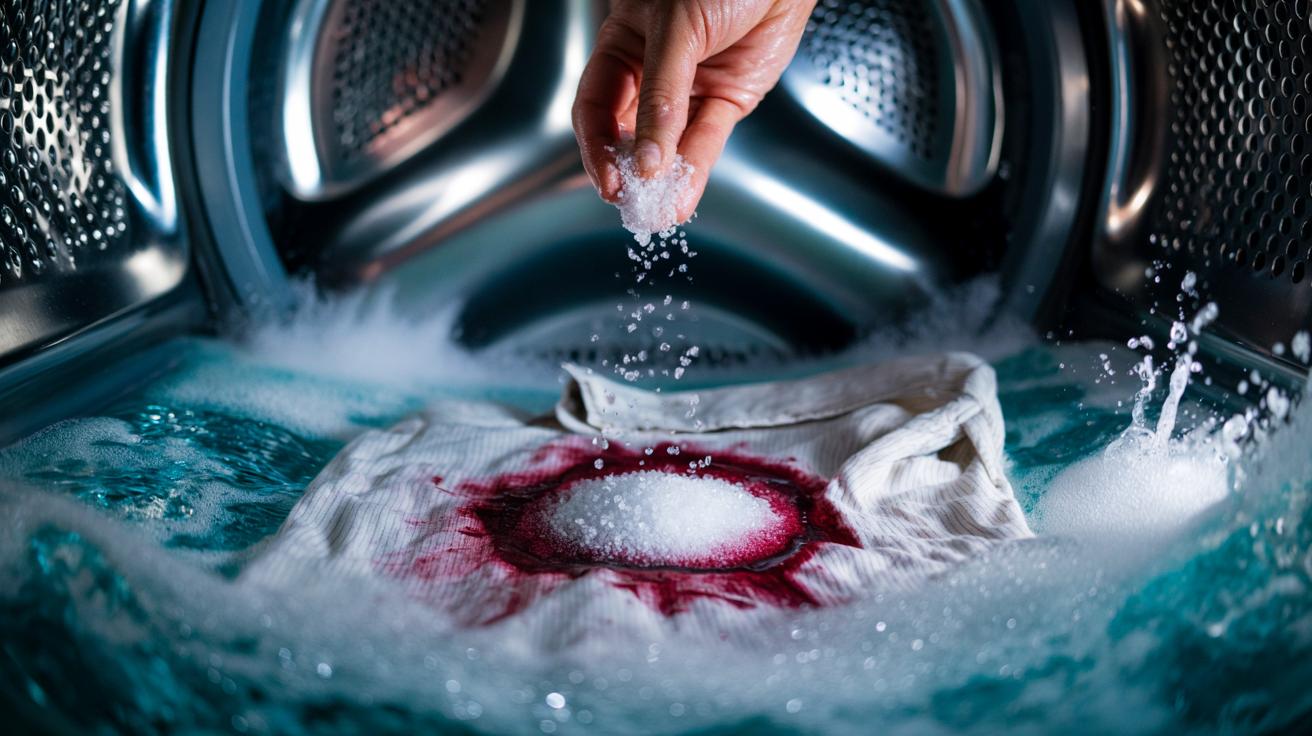
Detergent struggles with certain tannin stains and pigment-heavy splashes because particles cling electrically to fibres or lodge in weave gaps. A scatter of salt over a fresh red wine patch draws liquid and dye away from cotton before they penetrate, buying time until a proper wash. In the machine, a teaspoon or two can sharpen surfactant efficiency on mixed soils — the typical combination of body oils, street dust, and food traces. Salt excels early, when stains are fresh and detergent hasn’t yet had to work against set-in residues. It’s especially useful on robust fabrics like denim, canvas, towelling, and cotton shirting.
Where grease dominates, detergent remains the lead actor, but salt plays a supporting role by encouraging bigger, tighter micelles that hold oils more securely during rinse. It can also temper early dye bleed from new, deeply coloured garments, reducing the chance of a faint tint migrating onto lighter items in a mixed load. Note the caveat: too much salt can flip the advantage, destabilising surfactants or leaving crystalline residue. Precision beats excess — a pinch is power; a handful is trouble.
How to Use Salt Safely in Your Wash
Success rests on proportion and method. For a standard front-loader, add 1–2 teaspoons of table salt to the drum with your usual dose of detergent; in high-efficiency machines and soft water areas, start at 1 teaspoon. Pre-treat fresh spills by sprinkling salt directly, letting it wick moisture for a minute, then dabbing away before laundering. For stubborn patches, make a pea-sized paste of salt and cool water, massage gently with your fingertips, and rinse before the main wash. Always test on an inconspicuous seam if the fabric is delicate or labelled “colour-care only.”
Match your approach to fabric and stain. Avoid vigorous rubbing on silk or fine wool; use enzyme detergents for dried protein stains instead. Don’t rely on salt to “soften” hard water — it doesn’t; that’s the job of builders or a plumbed softener. Keep quantities modest to protect appliance components and maintain rinse clarity.
| Fabric | Stain Type | Salt Amount | Technique | Detergent Pairing |
|---|---|---|---|---|
| Cotton (white) | Red wine / berries | 1–2 tsp | Cover fresh spill; dab, then wash | Bio or oxygen bleach |
| Denim / dark cotton | Dye bleed control | 1 tsp in wash | First 2–3 washes | Colour-care detergent |
| Towels / sportswear | Mixed soils, light odour | 1–2 tsp in wash | Normal cycle | Bio detergent |
| Silk / wool | Makeup, surface grime | Pinch as paste | Spot treat gently; rinse | Delicates liquid |
Limits, Risks, and Myths to Avoid
Salt is not a silver bullet. Oily stains still demand proper surfactants; set-in protein marks (blood, egg) respond best to cold water and enzymes. Do not pour half a cup of salt into the drum and expect miracles — excess can hinder detergents and, over time, isn’t kind to metal parts. Modern stainless-steel drums are resilient, yet repeated high-salt exposures in damp crevices accelerate corrosion risk. Keep doses small, rinse thoroughly, and avoid use in every single wash unless there’s a clear purpose.
Two myths persist. First: “Salt softens wash water.” False — sodium chloride doesn’t remove hardness ions in the drum, though it regenerates ion-exchange resins in plumbed softeners. Second: “Salt sets all colours.” Not universally. It can temper loose dye on cellulosics early on, but it won’t fix unstable finishes or poor-quality dyes. Check care labels, separate brights initially, and trust a colour-catcher sheet when in doubt. Think of salt as a targeted enhancer that earns its keep when used sparingly and smartly.
Used with intent, salt gives detergent an immediate edge: bigger, better micelles in the wash and fine-grain lift at the stain site. It’s cheap, fast and familiar, ideal for first-aid on spills and taming dye drama in those nerve-racking first washes. Keep quantities modest, favour pre-treatment on fresh marks, and let enzymes or oxygen bleach take over when chemistry demands. Ready to run a simple A/B test — one load with a teaspoon of salt, one without — and see which basket comes out brighter?
Did you like it?4.6/5 (25)