In a nutshell
- 🧽 Tea towels excel on glass because of capillary action in cotton and linen fibres, delivering even absorption for a streak-free finish.
- 🧵 Choose tightly woven, lint-free cloths: cotton for main drying, linen for polish, and microfibre for precise buffing and edges.
- 🔄 Use a simple two-cloth routine: a damp cleaner followed by a dry finisher, working top-to-bottom in an overlapping S-pattern.
- 🧺 Maintain performance with proper laundry: wash separately at 40–60°C, avoid fabric softeners, and use occasional vinegar resets to restore capillarity.
- 💧 For hard-water areas, include a light vinegar pass and assign dedicated glass-only towels to keep results consistently spotless and lint-free.
There’s a small domestic secret that window cleaners and fastidious homeowners in the UK swear by: the humble tea towel. When chosen well and used with intent, its woven fibres draw water across glass in a remarkably uniform way, leaving a crisp, streak-free finish. The physics is simple yet satisfying: capillary action in a dense weave moves droplets into the cloth, while the broad surface area spreads moisture evenly before it can dry patchily. The result is a spotless pane without blue sprays or paper-waste. This article unpacks the science of the fabric, the kit you need, and the no-nonsense method that turns washing-up linen into a professional glass dryer.
Why Tea Towel Fibres Excel at Window Drying
At the heart of the tea towel trick is the way cellulose fibres in cotton and linen attract water. Each fibre behaves like a miniature channel, pulling liquid along by capillary action. Because a tea towel offers thousands of these channels in parallel, moisture is drawn off the pane quickly and distributed across the cloth. Even absorption prevents the tell-tale film that causes streaks. A tight, plain weave spreads pressure evenly over glass, so you remove water rather than chase it around.
Linen, with its slightly stiffer, flatter yarns, gives crisp contact and minimal lint, while high-quality cotton balances softness with strong uptake. The trick is not just how much water the towel can hold, but how evenly it can move that water away from the surface. Microtextured fibres increase surface area, so the towel wicks, holds, and releases moisture predictably. The effect is a controlled dry that outperforms paper or old T-shirts, which often shed fluff and leave smears.
Choosing the Right Cloth: Cotton, Linen, and Microfibre Compared
For consistently clear panes, pick a towel that is lint-free, tightly woven, and sufficiently thirsty. Classic cotton tea towels (200–260 GSM) are versatile and forgiving, while linen excels at a polished finish thanks to its smooth yarns. Microfibre isn’t a traditional tea towel, but its ultra-fine filaments deliver exceptional wicking when used as a secondary buffing cloth. The sweet spot is a cloth that absorbs quickly yet releases moisture evenly as you move. Avoid fluffy terry towels on glass; their loops can streak and shed. If your windows show hard-water shadows, keep a separate towel for a light vinegar pass, then dry with your best glass-only cloth.
| Material | Typical GSM | Absorbency | Lint Risk | Best Use |
|---|---|---|---|---|
| Cotton (plain weave) | 200–260 | High, steady | Low | Main drying pass |
| Linen | 170–230 | Moderate–high | Very low | Final polish |
| Microfibre | 200–320 | Very high | Very low | Buffing/edges |
Look for hemmed edges and a smooth, flat hand. Pre-wash new towels to remove finishing agents. Steer clear of fabric conditioners, which coat fibres and reduce capillarity. A modest stack—two cottons for removal, one linen for polish—covers most windows, mirrors, and shower screens efficiently.
The Step-By-Step Tea Towel Technique
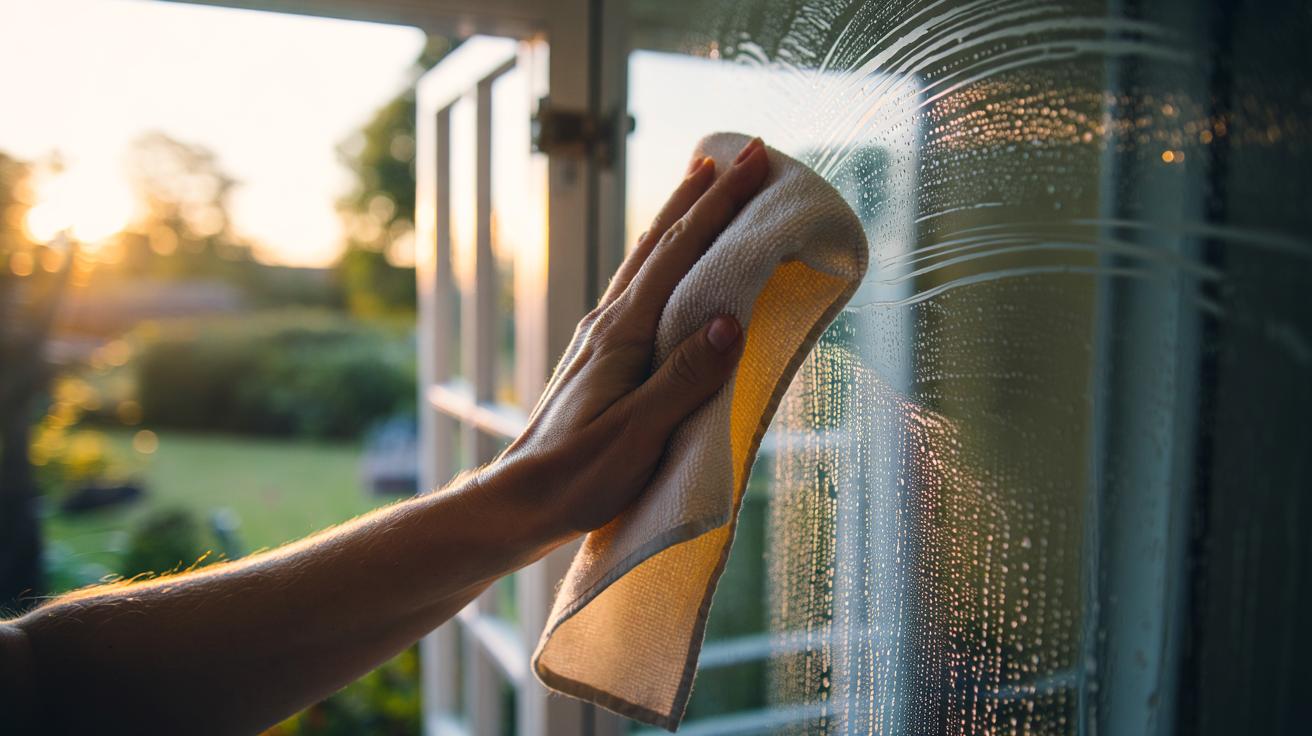
Start with clean glass. Use warm water with a drop of washing-up liquid or a 1:10 white vinegar solution. Wring a dedicated cloth until it’s damp, not dripping. Work the pane in a firm S-pattern, overlapping lanes by a finger’s width to keep the wet edge under control. Always move from top to bottom so gravity works for you. The aim is an even film that you immediately collect, not puddles that can dry into marks.
Switch to a dry tea towel for the crucial removal pass. Fold it into a neat pad to present a fresh face as it loads with moisture. Glide with light, consistent pressure; let the fibres do the uptake. Trace edges, frames, and corners—where drips lurk—with a narrow fold. If you see a faint trail, rotate to a drier section and give a light buff. Keep two piles: one “wet workhorse,” one “dry finisher.” This simple two-cloth method is the difference between decent and dazzling.
Care, Hygiene, and Reuse: Keeping Towels Performing
Performance lives and dies in the laundry. Wash window towels separately at 40–60°C with a plain detergent; skip fabric softener and dryer sheets, which smother fibre pores. For a quarterly reset, run an empty machine with hot water and a cup of white vinegar, then launder the towels to strip residues. Residue-free fibres regain their capillary pull and dry glass more evenly. Tumble on low or line-dry thoroughly; trapped humidity breeds odour and dulls uptake.
Store cloths flat and dust-free. Assign a simple code—one stitched corner for “wet work,” two for “polish”—to avoid cross-contamination. Retire any towel that starts shedding. If you live in a hard-water area, a brief vinegar rinse after washing prevents mineral stiffening. Maintain a small rotation so each towel rests between jobs; the fibres recover, and your lint-free finish remains reliable week after week.
In an age of gadgets and gels, the tea towel remains a quiet champion of clean glass. Its even absorption and smooth glide turn a domestic staple into a precision instrument for drying and polishing windows without fuss. With the right weave, a disciplined wash routine, and a simple S-pattern technique, you’ll beat streaks, banish lint, and save on disposable products. Small adjustments—top-to-bottom passes, folded pads, and a separate finisher—elevate the result from good to immaculate. What combination of cloths and routine suits your panes, your water type, and your weekly rhythm—and what will you try first to make the tea towel trick your own?
Did you like it?4.4/5 (27)