In a nutshell
- 🎰 Social feeds run on variable rewards that trigger dopamine-driven desire, making each swipe a gamble that reinforces scrolling.
- 🔁 Design patterns like infinite scroll, autoplay, and pull-to-refresh remove stop cues and compress decisions, extending sessions with minimal friction.
- 🧠 Our biases—novelty, FOMO, and salience—plus hyper-personalisation make the brain especially vulnerable, fragmenting focus even after you log off.
- 🏛️ Platforms optimise engagement via A/B tests and KPIs, while UK measures like the Age Appropriate Design Code and Online Safety Act press for safer defaults.
- 🧭 Practical levers: disable autoplay, batch notifications, restore stop cues, use follow lists over discovery tabs, and switch to grayscale to align your phone with your intentions.
Open an app “for a minute”, and an hour vanishes. That isn’t a lapse of willpower; it’s the result of products engineered to capture and hold attention. Social platforms exploit the brain’s dopamine signalling to reward every flick, tap, and pause with tiny, enticing payoffs. Endless scrolling is not a neutral design choice; it is a behavioural funnel calibrated to keep you engaged. From the colour of badges to the cadence of alerts, the experience is tuned to maximise your time-on-platform. Understanding the mechanics behind this pull is the first step to reclaiming agency in a world optimised for compulsion.
The Dopamine Loop Behind the Feed
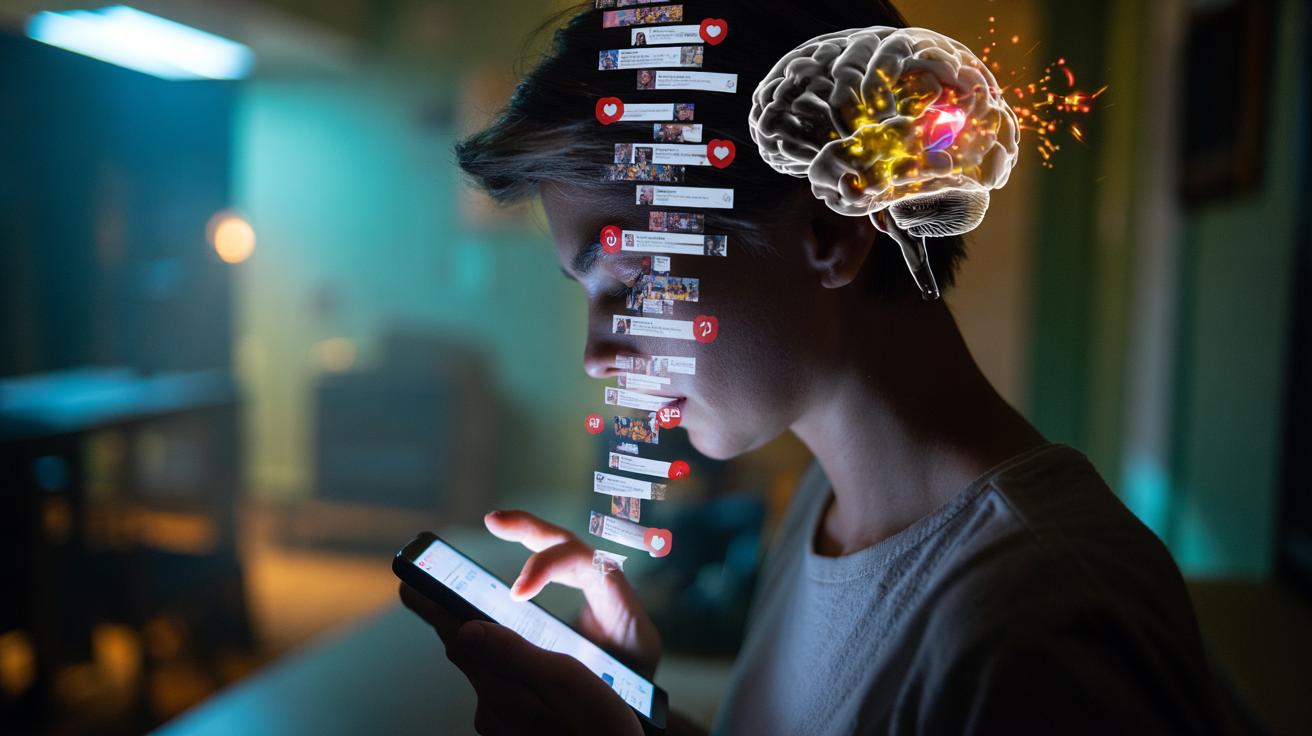
Social feeds are built on a classic variable reward schedule, the same learning pattern that makes slot machines so sticky. Your brain predicts what might come next; when a post exceeds expectations, a reward prediction error triggers a dopamine pulse that says “remember this, do it again.” Crucially, dopamine doesn’t create bliss; it creates desire. Your brain learns to crave the next unpredictable hit, not the content itself. Likes, comments, and follows function as micro-rewards, mixed with streaks of mediocrity to keep anticipation simmering.
The infinite scroll removes stop cues, letting the loop run uninterrupted. Each swipe is a tiny gamble: will the next item delight or disappoint? When it delights, the signal strengthens the habit; when it disappoints, the cost is negligible, so you keep playing. This asymmetry—high potential payoff, low perceived risk—tilts the table in favour of scrolling far past intention. It’s reinforcement learning at industrial scale, executed through elegantly simple gestures.
Design Tricks That Stretch Your Session
Attention is extended by bundling small optimisations into one irresistible flow. Autoplay removes decision friction, pull-to-refresh mimics a slot handle, and infinite scroll deletes the natural pause that a page break would impose. Social proof counters (hearts, views, shares) amplify the pull of popularity, while notifications drip prompts into quiet moments to restart the loop. Every design choice is tested against a single outcome: more minutes, more returns, more taps. These tweaks don’t just prolong sessions; they restructure habits by embedding themselves into commutes, bedtimes, and breaks.
The results are measurable at both the UI and neural levels: easier seeking, compressed decision time, and a tighter reward cycle. Features cross-pollinate across platforms, converging on the same behavioural blueprint. What looks like convenience is often a precise mechanism for extracting attention with minimal resistance. The table below summarises how the most common patterns convert curiosity into time spent.
| Feature | Mechanism | Dopamine Cue | Result |
|---|---|---|---|
| Infinite Scroll | Removes stop cues | Unpredictable next item | Longer sessions |
| Autoplay | Auto-initiates media | Effortless reward | Reduced exit rate |
| Pull-to-Refresh | Slot-machine gesture | Variable reinforcement | Repeat checks |
| Badges & Counters | Social proof & urgency | Anticipation of feedback | Compulsive checking |
Why Your Brain Is Vulnerable
Human cognition is biased toward novelty, social signals, and potential rewards—precisely what feeds supply in abundance. Novelty bias draws the eye to fresh posts, FOMO primes us to avoid missing updates, and salience filters elevate bright badges over quieter tasks. When cues and rewards arrive in rapid, irregular bursts, self-control becomes an uphill climb. The prefrontal cortex, responsible for planning and restraint, tires quickly; the reward system does not. That imbalance creates the subjective sense of “just one more” even when you wish to stop.
Personal algorithms add a further twist. Hyper-personalisation learns your triggers—topics, creators, times of day—and stacks them into a persuasive sequence. The feed adapts to your vulnerabilities faster than you adapt to it. Distraction becomes bespoke, tuned to your rhythms and cravings. For adolescents and tired adults alike, depleted sleep and stress lower resistance, turning casual use into compulsion. The outcome isn’t simply lost time; it’s fragmented focus that lingers after you put the phone down.
What Platforms Know—and What You Can Do
Inside these companies, teams A/B test everything from thumbnail contrast to vibration patterns, chasing engagement KPIs such as watch time and retention. When a tweak yields a fractional lift in minutes, it scales to millions of people overnight. Regulators are catching up: the UK’s Age Appropriate Design Code and the Online Safety Act push platforms toward safer defaults for young users. Yet the commercial incentives remain: more attention equals more data, ads, and investor-friendly growth curves.
Agency is not all-or-nothing. Disable autoplay, batch notifications, and restore stop cues by setting timed reminders or moving apps off the home screen. Use “follow” lists rather than discovery tabs, and switch to grayscale to blunt salience. Design your phone so the easiest action aligns with your intention, not the platform’s. These are small levers, but they compound—especially when workplaces and schools normalise attention-friendly defaults and screen hygiene.
Social media’s grip is a triumph of design over deliberation, a tight coupling of interface and neurochemistry that turns idle moments into captive markets. Recognising the dopamine patterns doesn’t inoculate you, yet it gives you levers to pull and language to demand better choices—from products and policymakers alike. Attention is a finite public resource as much as a private one. If feeds are built to anticipate your next move, what counter-designs, habits, or rules would help you reclaim that next minute—and the one after?
Did you like it?4.6/5 (21)