In a nutshell
- 🔥 Hot spoon press: Use a warmed spoon and gentle rolling pressure to coax dents out; let heat do the work, reheating briefly as needed and cooling the ball afterward.
- 🧪 Polymer science: Near the glass transition (Tg), plastic softens and internal pressure from expanding air helps the shell spring back without melting.
- 🧯 Safety first: Avoid flames and boiling; apply short, controlled heat cycles, minimal pressure, and check for hairline cracks or seam damage.
- 🏓 Celluloid vs ABS: Older celluloid recovers at lower temperatures but marks easily; modern ABS needs slightly higher heat and holds shape more consistently.
- ⚠️ Know the limits: Repeated fixes can thin walls and affect bounce; keep repaired balls for practice and replace those with warping, rattles, or persistent dents.
It’s a party trick with physics stitched in: rescuing a dented ping pong ball using a hot spoon press. Veterans of club halls know the sight of a ball that flattened against a table edge, seemingly ruined. Yet with a little controlled heat and gentle pressure, the sphere often springs back, ready for more rallies. The secret lies in the plastic’s thermoplastic behaviour and the pressure difference inside the hollow shell. A carefully warmed surface allows the polymer to relax and re-form its curve without melting or scorching. Here’s how the technique works, why it’s effective, and when to leave a lost cause in the bin.
Why Ping Pong Balls Dent — and Why They Can Recover
Dents occur when impact forces exceed the shell’s ability to distribute stress. Classic celluloid and modern ABS balls are thin, stiff, and light, so a sharp strike creates a local collapse. The deformation is often elastic-plastic: the ball loses its perfect curve, but the material retains enough flexibility to be coaxed back. Inside the sphere, trapped air offers a subtle counter-force. Heat is the catalyst that lets the polymer chains move, while internal pressure encourages the dent to lift.
Because ping pong balls are hollow, a tiny expansion of the enclosed air helps push the skin outward as the plastic softens. What matters is reaching temperatures near the material’s glass transition—the point at which the shell becomes more rubbery without turning liquid. Too cool and the dent stays; too hot and you risk warping, seams opening, or a tell-tale gloss mark that affects spin. Aim for warmth, not a boil.
The Hot Spoon Press: Step-by-Step Method
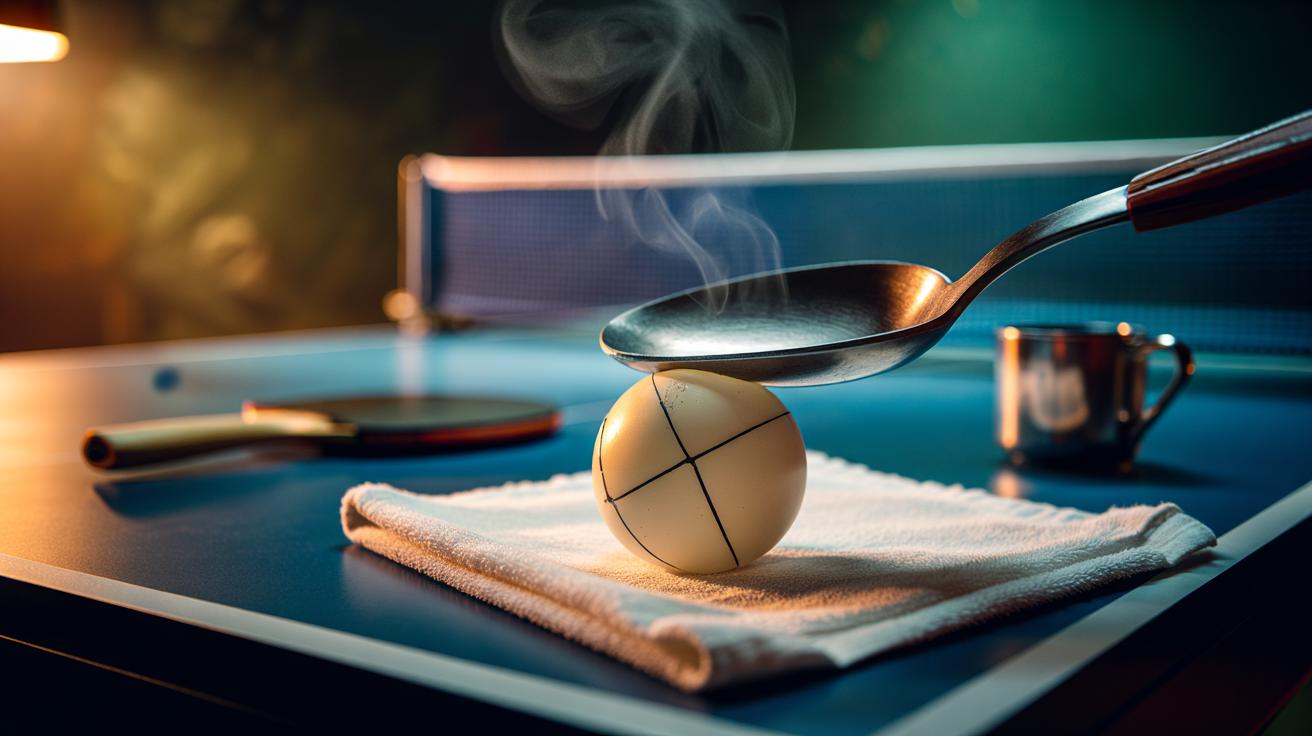
Start with a clean metal spoon and a mug of freshly boiled water. Dip the spoon for 5–10 seconds, then wipe it dry. Place the dented ball on a soft towel to prevent slipping. With the spoon’s back, apply a gentle, rolling motion over the dent. The warmth should be enough to soften the plastic locally; you’re not ironing clothes, you’re persuading a curve to return. Rotate the ball so heat spreads evenly. If needed, reheat the spoon for short intervals, checking progress after each pass.
Use minimal pressure; the heat does the heavy lifting, the spoon merely guides the shape. Avoid direct flames and aggressive presses that can create micro-cracks or thin spots. For stubborn dents, a waft of safe steam before the spoon pass can help, but keep exposure brief to protect the seam. Finish by letting the ball cool in ambient air. If the surface feels tacky or overly glossy, you heated too much—dial back and try a lighter touch next time.
The Science of Heat, Pressure, and Memory
Polymers such as celluloid and ABS have chain structures that stiffen below a threshold and relax above it. That threshold, the glass transition temperature (Tg), is central. When a warmed spoon kisses the dent, the local temperature nudges the shell toward rubbery behaviour, lowering internal stresses and letting the sphere’s geometry reassert itself. At the same time, the air inside the ball slightly expands with heat, adding a small but useful push.
The restoration is not magic—it’s a controlled dance between softened plastic, gentle pressure, and small rises in internal pressure. Older celluloid responds quickly because its Tg is comparatively low, while modern ABS needs a tad more heat yet better resists permanent warping. Both materials demand restraint: short exposures, even distribution, and constant checks. The goal is reversible reshaping, not a high-temperature cure.
| Ball Material | Approx. Tg (°C) | Heat Source | Typical Result |
|---|---|---|---|
| Celluloid (older) | 60–70 | Hot spoon, brief steam | Fast recovery; risk of gloss if overheated |
| ABS (modern 40+ mm) | 95–110 | Hot spoon, slightly warmer cycles | Steady recovery; better shape retention |
Safety, Limits, and When to Replace the Ball
Safety starts with moderation. Never heat the ball over an open flame or submerge it in boiling water. Both approaches invite warping, seam failure, or even a split that sends shards across the room. A warmed spoon gives precise, local control that respects the material’s limits. Remember that repetitive rehabs fatigue the shell; every rescue thins the wall slightly and may alter bounce or spin predictability.
Check for hairline cracks around the logo and seam. If you hear a rattle, the inner layer could be delaminating, and no amount of technique will restore consistency. Competitive players should reserve repaired balls for practice. For match play, imperfect roundness or a shiny patch can skew trajectory and fairness. Consider cost versus reliability: a timely replacement often saves missed shots, bruised egos, and safety headaches.
The hot spoon press proves how a touch of heat and a steady hand can revive a small, battered sphere. It’s a thrifty fix grounded in polymer science, not folklore. Use short heat pulses, steady motion, and a cool-down to secure durable results. Respect the limits of the shell, and it will reward you with a truer bounce. From club nights to garage tables, that little restoration can extend a ball’s life and your session’s rhythm. What refinements will you bring to the technique to balance speed, safety, and match-worthy performance?
Did you like it?4.5/5 (25)