In a nutshell
- 🌱 Turning less preserves fungal networks and builds stable aggregates, fostering a more fungal-dominant compost that boosts soil resilience and structure.
- 🔥 A low-turn approach stabilises moisture, heat, and aeration through passive airflow and structural carbon, preventing excessive drying while maintaining an active thermophilic core.
- 💧 Reduced disturbance improves carbon retention and curbs ammonia volatilisation, banking long-lasting humus and steady nutrients for plants.
- 🧪 Compost matured with minimal turning arrives loaded with beneficial consortia and supports mycorrhizal partnerships, enhancing nutrient use, water uptake, and disease suppression.
- 🛠️ Practical steps: build a breathable mix, monitor not meddle with a thermometer, keep covered for moisture control, and allow a longer cure for richer, soil-building compost.
Gardeners are told to turn their compost heaps religiously. Pitchfork out, aerate weekly, keep it moving. Yet a quieter method is winning over soil scientists and smallholders alike. Turning less often—sometimes not at all—can build a more biologically rich compost that translates into stronger, more resilient soils. Slower, steadier decomposition changes the balance of microbes, protects delicate structures, and reduces needless losses of moisture and nutrients. The surprising truth is that restraint can be more productive than effort when the goal is living soil, not just hot compost. Here’s why pausing before you plunge in can pay dividends beneath your boots.
Less Turning, Richer Biology
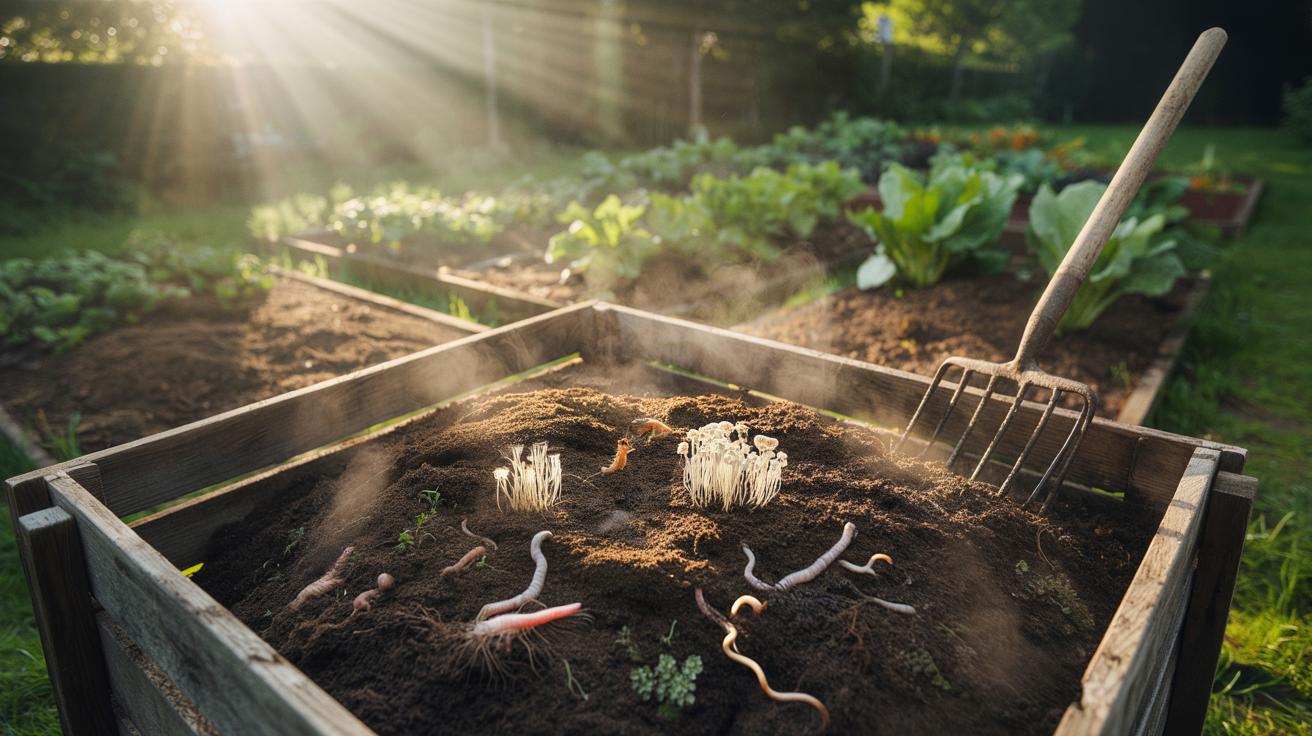
Every vigorous turn fractures fungal hyphae. Those gossamer threads knit organic particles into stable aggregates, laying the groundwork for crumbly, resilient topsoil. When you disturb them weekly, you select for fast-burning bacteria and sideline the slower, architectural fungi that build long-lasting humus. Turn less and you create space for a more fungal-dominant community to emerge—vital for perennial plantings, trees, and beds where drought resilience and structure matter.
By easing off the fork, you preserve the scaffolding that living fungi weave through your compost, and that scaffolding later becomes the skeleton of healthy soil. Many static or low-turn systems—think carefully ventilated bins or perforated-core piles—still receive enough oxygen for aerobic life, yet they prevent the repeated mechanical shock that resets microbial succession. The result is richer diversity, a broader enzyme toolkit, and compost that communicates with the soil food web rather than simply feeding it calories.
There’s also the animal workforce. Mites, springtails, and earthworms dislike constant upheaval. Allowing the heap to rest invites these small engineers to colonise, grind, and redistribute organic matter. Their castings boost cation-exchange capacity and introduce glues like glomalin, which help soils hold water and resist erosion. Less bustle, more balance.
Moisture, Heat, and Aeration: Finding the Balance
Frequent turning vents steam and accelerates drying. That can be useful if your heap is slimy, but over time it risks falling below the moisture sweet spot—about the feel of a wrung-out sponge—stifling biological activity. Low-turn piles hang on to moisture and heat, maintaining a stable thermophilic core that sanitises without constant intervention. Oxygen still matters, yet you can supply it passively with structure: coarse browns, twiggy stems, and side vents keep air moving without the weekly workout.
Think of it as tuning three dials—air, water, and temperature—rather than yanking a single lever. The table below sketches how different turning habits tend to play out in practice, assuming a well-built mix of carbon-rich browns and nitrogen-rich greens.
| Turning Frequency | Oxygen Pattern | Heat Retention | Microbial Tilt | Moisture Loss | Likely Soil Outcome |
|---|---|---|---|---|---|
| Weekly | Peaks and crashes | Often disrupted | Bacterial-leaning | High | Fast nutrients, less structure |
| Monthly | Moderate, more stable | Steady | Mixed community | Moderate | Balanced fertility and texture |
| Static, aerated | Consistent, passive | Stable core | Fungal-rich | Low | Stronger aggregates, improved water-holding |
Carbon and Nutrient Retention
Carbon is precious. Turning blasts oxygen through the heap, invigorating respiration. The microbes feast, burn faster, and vent more CO₂. That can finish a batch quickly, but it can also squander the stable carbon fractions that make compost valuable beyond a single season. Less agitation means less carbon lost to the sky and more carbon banked in forms that persist in soil. These forms deepen colour, cushion roots, and act as a pantry for nutrients and moisture.
Nitrogen is equally at stake. When we churn hot, high-nitrogen compost, we can spike pH and drive ammonia volatilisation; that is, nitrogen floats off as gas rather than staying put for crops. Low-turn systems tend to hold onto nitrogen, gently converting it into microbial bodies and stable compounds that release slowly once the compost is in the bed.
There’s a knock-on effect for phosphorus and trace elements. With steadier moisture and fewer temperature shocks, minerals are chelated and tucked into organic matrices rather than washing away. The payoff appears months later as consistent growth, darker foliage, and fewer signs of deficiency, even under erratic rain.
From Compost Pile to Soil Food Web
The endgame is not a perfect heap; it’s a living soil. Compost that matures under low disturbance often arrives teeming with beneficial consortia—bacteria, fungi, protozoa—that talk to plant roots via exudates. This biological conversation underpins disease suppression and nutrient efficiency in the field. Fungal-dominant compost, in particular, encourages mycorrhizal partnerships, which extend root systems and unlock phosphorus, zinc, and water from tight pores that roots alone cannot reach.
Structure follows biology. As those organisms move into your beds, they glue particles into crumbs, widen pores, and create channels for air and water. That means fewer puddles after rain, milder cracking in drought, and a seedbed that stays workable through a British spring that refuses to make up its mind. The soil begins to self-regulate, resisting compaction and bouncing back faster after a trampling or a storm.
In practice, that shows up as resilience rather than fireworks. Plants establish faster. Waterings stretch further. The same beds accept a lighter touch with fertiliser, because the soil food web is quietly servicing the crop. Low-turn compost doesn’t just feed; it organises.
Practical Tips for a Low-Turn System
Build for breathability on day one. Mix generous structural carbon—stems, shredded sticks, coarse straw—with finer browns and juicy greens at roughly a 2:1 ratio by volume. Lay a chunky base to lift the pile and, if you can, include a perforated centre pipe or slatted sides to encourage passive airflow. Good structure at the start beats corrective turning later. Keep initial moisture ample; materials should glisten when squeezed, not drip.
Monitor, don’t meddle. A simple compost thermometer tells you if the core is hot enough to pasteurise (55–65°C) and whether heat holds for several days. If temperatures stall early or odours turn sour, perform a single corrective turn and rebuild the structure, then return to patience. Cover the heap to fend off heavy rain and summer desiccation; consistent moisture under a lid outperforms heroic but erratic watering.
Allow a longer cure. Low-turn compost often benefits from an extended maturation phase, when the last sharp edges soften and fungal networks flourish. Screen lightly if you must, but leave some coarse fragments; they seed your soil with slow-release carbon and micro-habitats. When spreading, think thin and frequent—dustings into beds, mulchy collars around perennials—so biology migrates where roots are waiting.
Turning less is not laziness; it’s strategy. By protecting fungi, conserving carbon, and stabilising moisture and heat, a gentler regime creates compost that behaves like a soil builder, not just a quick fertiliser. The result is ground that holds together in rain, breathes in drought, and feeds crops with quiet reliability. As you plan your next heap, could a lighter touch—and a little patience—be the change that transforms your compost from hot heap to lasting soil health?
Did you like it?4.5/5 (23)